Meat cone size directly shapes your kitchen economics. A cone too large leads to dried-out edges, flavor loss, and product waste by the end of service. A cone too small forces your team to prepare replacements mid-rush, slowing ticket times and frustrating customers. The right size depends on measurable factors: daily customer count, average portion weight, machine capacity, and how quickly you can turn the cone over before quality drops. This guide walks through each decision point so you can match cone size to real operational demand rather than guesswork.
How to Calculate Shawarma Capacity Based on Daily Foot Traffic
Start with your actual sales data, not industry averages. Pull at least four weeks of POS reports and isolate shawarma-specific transactions. Separate lunch and dinner service, because peak demand windows dictate cone size more than daily totals do. A restaurant serving 200 shawarmas across 12 hours has very different needs from one serving 200 in a two-hour lunch rush.
Next, calculate your average portion weight per serving. Most operators serve between 120 and 180 grams of cooked meat per wrap or plate. Multiply your peak-hour sales by your portion weight to find the minimum cone mass you need ready during rush. For example, 80 shawarmas sold between 12:00 and 14:00 at 150 grams each requires 12 kilograms of cooked meat available within that window. Raw cone weight should exceed this figure by roughly 25 to 30 percent to account for cooking loss.
Foot traffic patterns also change by day of week and season. Fridays, weekends, and holidays often double weekday volumes. Build your cone rotation around your highest projected day rather than your average, or you will run out during the shifts that matter most. Pair this projection with walk-in counts if you track them, because not every visitor orders shawarma and your conversion rate affects how much raw product you actually need prepped.
Finally, factor in delivery and third-party app orders separately. These tickets often spike at unpredictable hours and can pull meat from your cone outside your expected rush. Restaurants with strong delivery volume typically benefit from maintaining two smaller cones running simultaneously rather than a single large one.
Matching Cone Size to Your Machine and Restaurant Concept
Your vertical broiler has a maximum load capacity, and ignoring it creates both safety and cooking quality problems. Standard commercial machines handle cones between 20 and 80 kilograms, but the listed capacity is not the ideal operating weight. Running a machine at its maximum load reduces heat penetration, leaves the inner core undercooked, and shortens motor lifespan. Choose a cone size that uses around 75 to 80 percent of your machine’s rated capacity for consistent results.
Burner configuration matters just as much as capacity. Three-burner and four-burner machines distribute heat across a longer vertical surface, making them suitable for taller, heavier cones. Two-burner units work best with shorter cones in the 15 to 30 kilogram range. Mounting a long cone on an undersized burner array leaves cold zones in the middle of the meat, forcing your staff to either wait longer between slices or serve underheated product.
Restaurant concept determines another layer of the decision. Fast-casual counters with high turnover and a short menu can justify large cones because the meat moves quickly enough to stay fresh. A full-service restaurant with shawarma as one item among many should lean toward smaller cones, since slower turnover means more exposure time and quality loss. Food trucks and ghost kitchens have their own constraints, usually favoring cones under 25 kilograms due to limited space and power supply.
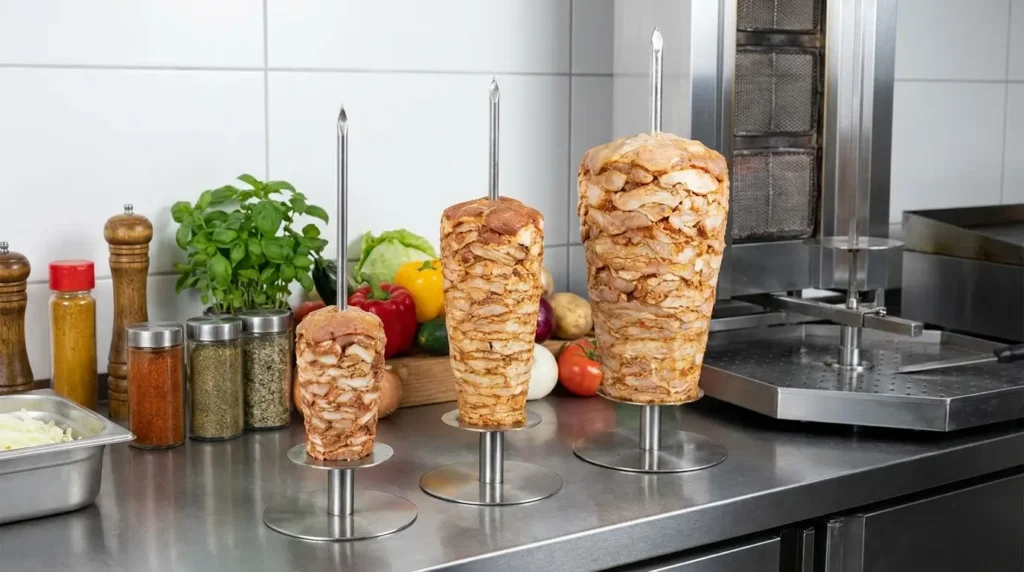
Consider ceiling clearance and ventilation in your kitchen layout before committing. A 60-kilogram cone stands significantly taller than a 20-kilogram one, and some machines require additional vertical space for loading. If your hood system was sized for a smaller setup, scaling up the cone can push grease and smoke beyond your extraction capacity, creating compliance issues with local health inspections.
Ideal Weight Choices to Minimize Waste and Boost Profits
Cone weight selection is a profit calculation, not a preference. Every kilogram of meat that dries out, gets discarded, or sits unsold at closing is a direct hit to your food cost percentage. Operators who match cone size to actual sales velocity typically run shawarma food costs between 28 and 32 percent. Those who oversize cones see that number climb past 40 percent within weeks.
The most common commercial cone weights used across restaurants fall into predictable ranges based on daily volume:
- 10 to 20 kilograms: Suitable for cafés, small takeaway shops, and restaurants selling fewer than 60 shawarmas per day. Allows full turnover within a single service period.
- 25 to 40 kilograms: The standard range for mid-volume restaurants handling 80 to 180 shawarmas daily with a defined lunch or dinner peak.
- 45 to 60 kilograms: Designed for high-traffic locations, mall food courts, and tourist-area operators serving 200 or more portions per day.
- 65 kilograms and above: Reserved for large-format restaurants, catering operations, and venues with continuous service from morning to late night.
Pricing per kilogram usually decreases as cone size increases, which tempts operators to buy larger than they need. The savings disappear quickly when unsold meat enters the waste bin. Calculate your true cost per served portion, not your cost per raw kilogram. A slightly more expensive smaller cone that sells out cleanly delivers better margins than a discounted large cone with 15 percent end-of-day waste.
Freezer and cold storage capacity also limits your realistic options. Larger cones require more prep space, bigger refrigerators, and longer thawing windows. If your walk-in cannot hold a backup cone alongside your active one, you risk running out during service or being forced to cook from partially frozen product, both of which damage quality and customer experience.
Why Turnover Time Matters for Serving Fresh Shawarma
Turnover time is the interval between loading a fresh cone and finishing the last slice. This single metric determines whether customers get juicy, properly caramelized meat or dry, reheated-tasting shavings. The ideal turnover window sits between 4 and 8 hours of active cooking. Beyond that range, outer layers lose moisture faster than the rotation can shave them off, and flavor degradation becomes noticeable.
A 40-kilogram cone selling at a rate of 5 kilograms per hour will finish in roughly 8 hours, which fits a single service day. The same cone moving at only 2 kilograms per hour stretches across 20 hours of cook time, meaning the meat that serves your dinner crowd was first exposed to heat during breakfast prep. Customers notice this difference even if they cannot name it, and repeat business suffers accordingly.
Staff workflow also depends on predictable turnover. When cones finish mid-service, kitchen teams scramble to load replacements while tickets pile up. Choosing a cone size that completes near the natural break between lunch and dinner, or at closing time, keeps operations smooth. Many successful operators run two medium cones per day rather than one oversized cone, using the mid-afternoon lull to swap and reset.
Temperature consistency inside the meat matters as much as surface searing. Cones that rotate too slowly develop a hardened outer shell that insulates the interior from further cooking, leading to inconsistent texture across servings. Matching cone weight to realistic shave rate keeps the entire mass within its ideal temperature zone throughout service.
How Menu Variety Impacts Your Ideal Cone Size
A shawarma-focused concept and a multi-category restaurant require fundamentally different cone strategies. When shawarma accounts for 60 percent or more of your sales, a single large cone makes operational sense because volume justifies the size. When shawarma sits alongside kebabs, grilled plates, salads, and rice dishes, customers distribute their orders across the menu and each item slows down.
Menu variety affects cone selection in several measurable ways that directly shape your kitchen strategy:
- Order distribution: Menus with more than 15 items typically see any single dish capture under 25 percent of total sales, reducing shawarma velocity.
- Protein overlap: Restaurants offering both chicken and beef shawarma need two smaller cones running simultaneously rather than one large single-protein cone.
- Side dish pairing: Concepts where shawarma is sold primarily as a plate with rice and sides often see smaller per-order meat portions than wrap-focused restaurants.
- Daypart balance: Menus serving breakfast items alongside lunch shawarma push demand into a narrower window, concentrating cone consumption.
- Combo offerings: Family platters and group meals drive higher meat volume per ticket, which can justify a larger cone despite fewer individual orders.
Seasonal menu changes also influence cone sizing decisions. Summer menus featuring lighter dishes and salads often reduce shawarma demand by 20 to 30 percent compared to winter, when heavier wraps and plates dominate. Reviewing your cone size quarterly rather than setting it once prevents the mismatch between stable ordering habits and shifting customer preferences.
Menu engineering can also pull demand toward or away from shawarma depending on how you position the dish. Featuring shawarma in combo deals, lunch specials, and promotional graphics increases velocity and may justify sizing up. Moving it off the main display or pricing it above competitors reduces velocity and demands a smaller cone to maintain freshness.
The Hidden Costs of Choosing the Wrong Size
Wrong-sized cones generate costs that rarely appear on a single invoice but accumulate across your P&L. The most obvious is product waste. An oversized cone with 10 percent end-of-day leftover running three times per week on a 30-kilogram cone equals roughly 9 kilograms of discarded meat weekly, which translates to meaningful monthly losses depending on your wholesale cost.
Energy consumption is the second hidden cost. Vertical broilers run continuously during service, and a partially loaded machine uses nearly the same gas or electricity as a fully loaded one. Running an oversized machine because you bought an oversized cone means paying for heat you are not monetizing. Over a full year, this inefficiency can exceed the cost of simply buying the correct machine from the start.
Labor costs rise with wrong-sized cones in less obvious ways. Undersized cones force mid-service replacements, which pull staff away from the front line and extend ticket times. Oversized cones require longer prep for loading, more intensive cleaning, and occasionally two people to lift onto the spit. Both scenarios increase labor minutes per shawarma sold, reducing the productivity ratios that drive profitability.
Customer-facing costs may be the most damaging over time. Shawarma quality depends heavily on turnover speed, and customers who receive dry or overcooked meat twice rarely return. Online reviews mentioning quality issues directly trace back to cone size mismatches more often than operators realize. Losing 5 percent of repeat customers due to quality complaints outweighs any savings from bulk-buying oversized cones.
Equipment wear rounds out the hidden cost list. Machines consistently pushed beyond recommended load capacity wear motors and bearings faster, leading to repair bills and downtime. A cone that fits within your machine’s ideal operating range extends equipment life by years and protects the capital investment you made when opening the restaurant.