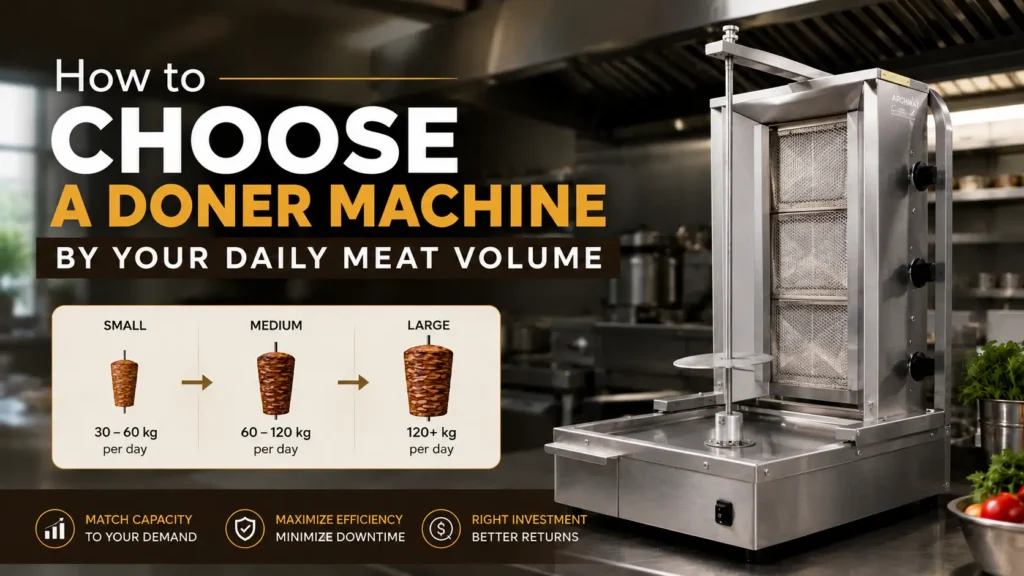
The biggest mistake operators make when buying a doner machine has nothing to do with brand loyalty or sticker price. It comes down to picking a unit that does not match the amount of meat they actually turn over in a single day. A broiler built for 30 kilos will fight you the moment you load 60 kilos onto the spit, and a five-burner giant running a thin cone simply burns gas to heat empty air behind the meat.
Daily meat volume is the figure that should drive every other choice: the number of burners, the motor position, the spit length, even the gas line your kitchen needs. Once that number is honest and accurate, most of the technical specification falls into place on its own. The trouble is that very few buyers sit down and calculate it properly before they shop.
This guide walks through how to read your own volume, what each burner range is built for, and where motor design quietly decides whether your machine lasts five years or fifteen. If you want to browse the configurations as you read, our full range of doner kebab equipment shows how these specs translate into actual models.
Why Matching Machine Capacity to Meat Weight is Crucial
A doner machine is essentially a heat budget. Each burner produces a fixed amount of radiant energy, and that energy has to cook the outer layer of the cone evenly from top to bottom while you shave it. When the cone is heavier and wider than the burners can reach, the centre stays cold, the surface chars unevenly, and your slicing speed drops because you are waiting for sections to come up to temperature.
Push the relationship the other way and the problems are just as real. An oversized machine running a light cone wastes fuel, overheats the immediate surface, and dries out the meat before you sell it. You pay more for the unit, more for gas every shift, and you still end up with a product that suffers in quality. Capacity is not a “bigger is safer” decision, it is a balance.
There is also a mechanical side that buyers tend to forget. The motor, bearings, and spit are all sized around an expected load. A unit rated for a 25 kilo cone that is asked to spin 50 kilos every day will wear its gears and bearings far faster than the warranty assumes. Matching weight to capacity protects the machinery as much as it protects the food.
Finally, capacity shapes your service speed at the counter. The right machine keeps a cooked, ready-to-slice surface available throughout your rush, so staff never stand idle waiting for the meat. That single factor often separates a shop that clears its lunch queue from one that loses customers to the wait.
How to Accurately Estimate Your Daily Meat Needs
Guessing your volume by gut feeling is how most operators end up with the wrong machine. The better approach is to build the number from real sales data, even if that data is only a rough estimate from a similar location. Start with your portion size, then work outward to a daily total you can trust.
Here is a simple way to reach a reliable daily figure:
- Set your portion weight. A standard doner or gyro portion usually sits between 120 and 180 grams of cooked meat. Pick the number that matches your menu.
- Estimate daily portions sold. Use your busiest realistic day, not a slow one, so the machine can handle peaks rather than averages.
- Multiply and add a buffer. Portions times portion weight gives your raw daily need. Add roughly 15 to 20 percent for cooking loss and trimming.
- Split across cones if needed. If your total is high, decide whether you will run one large cone all day or load fresh cones across two or three services.
Once you have that figure, compare it against the rated capacity of any machine you consider, and look at the rating per shift rather than a theoretical maximum. A unit that can hold 60 kilos is not the same as one that can cook through 60 kilos cleanly during a four-hour rush.
It also helps to think a season ahead. Many shops see summer footfall climb well above their winter baseline, and a machine sized only for the quiet months will struggle when the patio fills up. Build your estimate around the year you expect, not the week you are in.
1 to 2 Burners: Ideal for Small Cafes and Low Volume
Smaller burner setups exist for a reason, and that reason is precision rather than weakness. A one or two burner machine is designed to cook a slim cone evenly and economically, which is exactly what a café, a food truck, or a side-menu operation needs. If doner is one item among many on your board, this is usually where you belong.
These units typically handle cones in the lighter range comfortably, often up to around 30 to 40 kilos depending on the build. They draw less gas, take up minimal counter space, and reach working temperature quickly, so you are not heating a large cabinet for a modest amount of meat. For a venue selling a few dozen portions a day, that efficiency adds up over a month.
The trade-off is headroom. If your sales grow steadily, a two burner machine will reach its ceiling, and pushing a fat cone onto it undoes every advantage it had. The honest question to ask is whether doner is a core earner or a supporting act. If it is a supporting act, a compact machine paired with quality sliced proteins gives you consistency without overspending.
3 to 4 Burners: The Standard for Most Kebab Shops
Walk into a typical kebab shop and the machine behind the counter is almost always a three or four burner unit. There is a good reason this range became the default. It covers the volume that the majority of dedicated doner businesses actually sell, while staying manageable in terms of gas use, footprint, and price.
A four burner machine gives you even heat across a tall, full cone, which means you can keep a generous amount of meat cooking and ready throughout the day. This is the sweet spot for a shop that treats doner or shawarma as its main product and serves a steady stream of customers from lunch through to late evening. You get enough capacity for a real rush without the fuel bill of a heavy-duty unit.
The flexibility is part of the appeal too. On a quiet day you can run a slightly smaller cone and not waste much heat, and on a busy day you can load up close to the machine’s rating. That range of comfortable operation is why so many established operators settle here and stay. For most independent shops planning a doner kebab program, this is the safe, proven starting point.
If you are unsure whether three or four burners suits your layout and volume, it is worth talking through your numbers before you commit. A short conversation about your peak service often clears it up faster than any spec sheet.
5 Burners and Up: Heavy-Duty Machines for Busy Restaurants
When your daily meat volume climbs into serious territory, the rules change. Five burners and beyond are not built for the average shop, they are built for high-turnover restaurants, busy food courts, and central kitchens that run large cones from open to close. At this level you are cooking weight that smaller machines physically cannot keep up with.
The extra burners do more than add raw heat. They distribute energy across a taller, wider cone so that even a very heavy load cooks evenly from the top edge to the bottom. That even reach is what lets a high-volume kitchen shave continuously through a rush without sections of the cone lagging behind. Speed at the counter is the entire point of moving up to this class.
These machines also tend to come with stronger drivetrains, heavier spits, and more robust frames, because the equipment has to survive constant daily load. That durability is part of what you are paying for, and it is money well spent if your volume genuinely justifies it. Run the wrong product here and the strengths turn into waste, so the decision should always trace back to your real numbers rather than ambition.
Top Motor vs. Bottom Motor for Heavy Meat Cones
Motor position sounds like a minor detail until you are spinning a heavy cone every day, and then it becomes one of the most important things on the spec sheet. The two common layouts, motor at the top and motor at the bottom, each handle weight in their own way, and the right choice depends largely on how heavy your cones run.
A top-mounted motor drives the spit from above, which keeps the base of the machine clear and open. That open base makes slicing at the lower end of the cone easier and keeps the drip area cleaner. The catch is that the full weight of the cone hangs in tension, so for very heavy loads the motor and its bearings need to be genuinely strong to avoid strain over time.
A bottom-mounted motor supports the cone from below, with the weight resting down toward the base rather than hanging. For the heaviest cones, many operators find this layout reassuring because the load sits on a supported point instead of pulling against the drive from the top. The trade-off is a slightly more enclosed base, which can take marginal getting used to during slicing.
In short, lighter and medium cones run happily on either design, so your decision can come down to cleaning preference and counter layout. Once your cones get genuinely heavy, prioritise the strength of the motor and bearings over the position itself, because a well-built drive matters more than where it sits.
Should You Buy a Larger Machine “Just in Case”?
It is tempting to size up beyond your current needs, just to be ready for growth that may arrive. Sometimes that instinct is right, and sometimes it quietly costs you money every single shift. The honest answer depends on how realistic your growth plan is and how the extra capacity behaves on a normal day.
Here is how the two sides tend to balance out:
- The case for sizing up: if you have firm plans to expand the menu, extend hours, or open to higher footfall soon, a larger machine saves you from buying twice. It also gives breathing room on unexpected busy days.
- The case against it: an oversized unit burns more gas heating space your cone does not fill, can dry the surface of a light load, and ties up capital you could spend elsewhere. The wear-saving benefit only appears if you actually use the capacity.
A more practical middle path is to size for your realistic peak, plus a sensible buffer of around 15 to 20 percent, rather than jumping a whole class up. That margin handles seasonal spikes and steady growth without leaving you running half-empty for years. If a real expansion lands later, a second machine often makes more sense than one giant unit that was oversized from day one.
To summarise the whole decision: start from an honest daily meat figure, match it to the burner range that cooks that weight cleanly, then let cone weight guide your motor choice. Get those three right and you end up with a machine that fits the way you actually trade. If you would like a hand matching your numbers to the right configuration, our team is glad to help through the contact page, and you can find more practical setup advice in our how-to guides.