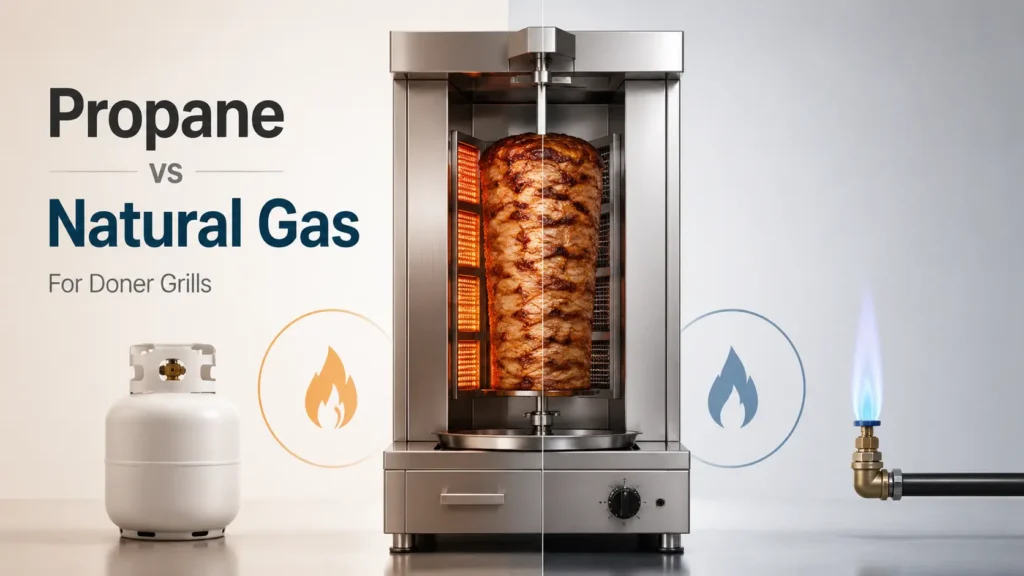
Most gas doner grills are sold as two versions of the same machine. One is plumbed for natural gas, the other is set up for propane. The burner box, the motor, the spit and the stainless housing are usually identical. What changes is the size of the burner orifice, the regulator on the inlet and the pressure the gas arrives at. That one difference decides your monthly fuel bill, your installation cost and, in some buildings, whether you are allowed to run the machine at all.
The raw numbers explain why the two are not interchangeable. Propane carries roughly 2,500 BTU per cubic foot, while natural gas sits near 1,030. Propane also reaches the burner at about 10 to 11 inches of water column, compared with 3.5 to 7 inches for natural gas. More energy in a smaller volume, delivered at higher pressure, so propane burners need noticeably smaller openings to release the same heat. Feed one fuel into a machine drilled for the other and you either get a lazy yellow flame that will never brown a cone, or a flame far larger than the burner was designed to hold.
Picking a side is not really about which fuel is better. It is about what your building already has, how you serve, and how much you cook in a day. This guide walks through the cost per hour, the connection work, the code side, and the questions that come up most often when an owner is about to place the order and suddenly realises the drop-down menu says “natural gas or LP” with no explanation attached.
Where the Two Fuels Actually Differ Inside the Burner
Natural gas is mostly methane, delivered through a municipal line at low pressure and billed by volume or by therm. Propane is a compressed liquid stored in a cylinder or tank, which turns back into gas as it leaves the valve. Because it is stored as a liquid, a small vessel holds an enormous amount of fuel: a standard 20 lb cylinder carries roughly 430,000 BTU, which is about the same energy a natural gas line would take twenty minutes to deliver at typical restaurant flow rates.
The orifice is where the design difference lives. It is a brass fitting with a precisely drilled hole that meters gas into the burner venturi. Because propane is more than twice as energy dense, its orifice is drilled smaller so that a comparable amount of heat comes out. A natural gas orifice on a propane supply passes far too much fuel, which is exactly the situation that produces flames rolling out of the burner box and soot on the back of the machine. This is not a tuning issue you can solve with the control valve.
Pressure matters just as much. A propane regulator steps tank pressure down to a stable 11 inches of water column. Natural gas arrives at the meter already low and is regulated again at the appliance. If you install a machine built for one pressure on the other supply, the burner never reaches its rated output or it overshoots it, and neither situation is safe to leave running eight hours a day in a busy kitchen.
There is one practical takeaway from all of this. When you order a gas machine, the fuel type is part of the specification, not an accessory. Confirm it in writing before the unit ships. Most of the gas doner grills we build are configured at the factory for the fuel you specify, and that configuration is what arrives on the truck.
What Each Fuel Really Costs to Run
Fuel cost is the argument most owners care about, and here natural gas wins on paper almost every time. Commercial natural gas in the United States is usually billed by the therm, which is 100,000 BTU, and commercial rates commonly land somewhere between one and two dollars per therm depending on the state and the season. Propane delivered to a restaurant tank has been running in the three to four dollar range per gallon, and a gallon holds about 91,500 BTU.
Run those figures through a real machine and the gap becomes clear. A typical four burner doner grill draws somewhere around 40,000 BTU per hour at full output. On natural gas that is roughly 0.4 therm an hour, so call it forty to eighty cents. The same machine on propane burns close to 0.44 gallons an hour, which lands nearer to a dollar thirty or a dollar seventy. Over a ten hour day, six days a week, that difference is not trivial. It is the sort of number that quietly adds up to a few thousand dollars across a year.
Worth remembering, though, is that a doner grill rarely runs at full output. You light the burners nearest the meat and shut down the ones facing an empty spit, so actual consumption often sits well below the rated maximum. A shop running a half loaded cone through a slow afternoon might be burning a third of the plate figure. That narrows the absolute gap between the two fuels even if the percentage stays the same.
The other half of the propane bill is the part that does not appear on a per gallon quote. Tank rental, delivery charges, minimum order sizes and the occasional emergency drop all add cost. Cylinder exchange programmes, which are convenient for small operators, work out considerably more expensive per BTU than bulk delivery. If you plan to stay on propane long term, negotiating a bulk contract with a local supplier is usually worth more than shaving a few cents off the equipment price.
Gas Lines, Cylinders and the Cost of Getting Connected
Natural gas is only cheap if the pipe already exists. Bringing a new line into a space, or upsizing an existing one to handle the added load, means a licensed plumber, a permit and often a coordination visit from the utility. Costs vary wildly by city, but the work is rarely quick, and a doner grill added to a kitchen that already runs a range, a fryer and a griddle can push the total demand past what the current line size supports.
That last point catches people out. Gas piping is sized for the combined BTU load of every appliance on the run, and a five burner doner machine is a meaningful addition. If the line is undersized, the symptom is not a failure but a slow starvation: the doner grill runs fine on its own, then the flames drop as soon as the fryer recovers. Have your plumber calculate the load before the machine arrives rather than after.
Propane sidesteps all of it. You place the machine, connect a hose and regulator to a cylinder or an outdoor tank, and you are cooking the same afternoon. That freedom is why almost every mobile operation runs on propane, and why pop up stands, festival pitches and seasonal kiosks rarely consider anything else. The trade off is that you now own a fuel logistics problem, and running dry in the middle of a Friday rush is a mistake most operators only make once. If you are moving from a mobile setup into a fixed unit, our guide on going from food truck to storefront covers the equipment side of that transition in more detail.
Which Fuel Suits Your Type of Operation
There is no universally correct answer, but there is usually an obvious one once you describe how you actually trade. The decision tends to fall out of your location and your service pattern rather than any property of the fuel itself. Below are the situations that come up most often in the kebab trade, and where each one normally lands.
- Fixed storefront with an existing gas line. Natural gas, without much debate. The line is already there, the running cost is lower, and you never think about the fuel again.
- Food truck, trailer or mobile cart. Propane, always. There is no alternative when the kitchen moves, and the whole vehicle is already designed around cylinder storage.
- New build or a unit with no gas service. Compare the one time cost of bringing a line in against several years of propane delivery. If you hold a long lease, the line usually pays for itself. On a short lease, it rarely does.
- Catering, festivals and event work. Propane, for the same reason as the truck. Portability beats fuel economy when the site changes every weekend.
- Rural sites and areas without a mains network. Propane by default, ideally on a leased bulk tank rather than exchange cylinders.
- High volume shop running two or three machines. Natural gas if it is available at all. At that load the annual saving is large enough to justify significant pipework.
One more scenario deserves a mention: the shop that keeps a propane grill as a backup even though it runs on natural gas. It costs little, it keeps you trading through a utility outage, and it doubles as your outdoor catering unit. Plenty of established operators do exactly this.
Does Propane Cook a Doner Cone Better?
You will hear this claim in every equipment showroom, usually phrased as “propane burns hotter.” It is true that propane has a slightly higher flame temperature and far more energy per unit of volume, but that is not the same as saying the finished cone will be better. A burner rated at 40,000 BTU produces 40,000 BTU whether it is fed propane or natural gas, because the orifice was sized to make that happen.
What you may notice is recovery behaviour. Propane systems tend to hold pressure well and can feel a touch more responsive when you open the valves after loading a cold cone. Natural gas at the low end of its pressure range, particularly on a busy shared line, can feel slower to come back. That is a supply characteristic rather than a fuel characteristic, and a properly sized line removes the difference entirely.
Where cooking quality genuinely comes from is the geometry of the machine and the way the meat is stacked. Burner spacing, the distance between the flame plate and the cone, the evenness of the rotation and whether the spit is driven from the top or the bottom all matter far more than what is in the pipe. We have written separately about why a doner cone cooks unevenly, and fuel type barely appears on that list.
So if someone tries to sell you a propane machine on the promise of a better crust, treat it as a sales line. Choose the fuel on cost and logistics, then choose the machine on build quality, burner layout and motor position. That order of priorities will serve you better.
Converting a Doner Grill from One Fuel to the Other
Sometimes the situation changes. You move premises, the landlord finally runs a line, or you buy a used machine that came set up for the wrong supply. Conversion is possible on most commercial gas doner grills, but it is a mechanical job with real consequences if it is done casually, and it is not something to attempt with a drill and a YouTube video.
A proper conversion means replacing parts, not adjusting them. Ask the manufacturer for an approved kit for your exact model, and have a licensed gas technician fit it. Here is what the work normally involves:
- New burner orifices sized for the target fuel, one for every burner on the machine.
- A different regulator, since the two fuels operate at different outlet pressures.
- Gas valve or pressure adjustment, which on some models means a replacement valve rather than a setting change.
- A new inlet connection and hose, particularly when moving to propane, where a hose and quick disconnect replace a hard pipe.
- A pressure test and combustion check after the work, confirming the manifold pressure matches the rating plate.
- An updated rating plate or fuel label, which inspectors do look for.
Two warnings are worth repeating. First, an unapproved conversion can void the warranty on a new machine, and it will certainly complicate any insurance claim following an incident. Second, if the machine is old enough that the manufacturer no longer supplies a kit, the conversion is often not worth doing at all. At that point, compare the cost of the work against what a new machine actually costs before committing.
Safety, Ventilation and the Rules Your Inspector Will Check
Both fuels are safe when installed correctly, but they fail in different ways, and your local fire code reflects that. Propane is heavier than air, so a leak settles at floor level and pools in pits, drains and basements. Natural gas is lighter and rises, which means it disperses more readily but can collect in a ceiling void. Detector placement follows the same logic: low for propane, high for natural gas.
Cylinder storage is where propane operators get caught. Fire codes place tight limits on how much propane can be kept inside a building, and in most commercial kitchens the practical answer is that spare cylinders belong outside in a secured, ventilated cage, not in the back corridor. Rules differ between jurisdictions, so confirm the specifics with your local fire marshal rather than assuming what worked at your last site still applies.
Ventilation requirements are the same regardless of fuel. A gas doner grill is a cooking appliance producing heat, grease vapour and combustion by products, so it needs to sit under a Type I hood with proper make up air. Skipping this is the fastest way to fail an inspection, and it also ruins the working conditions for whoever is carving all evening.
Certification is the last piece. Health departments in the United States generally expect commercial cooking equipment to carry NSF certification, and gas equipment to carry a recognised gas safety listing. If you are unsure what your inspector will ask for, our overview of NSF certified doner equipment explains which marks matter and why they get checked.
Match the Burner Count Before You Match the Fuel
Fuel type is the easier of the two decisions. Getting the machine size right is the one that affects your food cost and your service speed every single day, and it deserves the bulk of your attention. A two burner unit handles around 44 lbs of meat and suits a small cafe or a side of menu offering. A five burner machine carries up to 170 lbs and is built for a shop where doner is the main event.
Oversizing is a more expensive mistake than undersizing. A cone that sits on a half lit machine through a quiet afternoon dries out at the surface and loses weight to shrinkage, and you pay for that in both fuel and product. Undersizing costs you sales at peak, but at least the meat you do sell is at its best. Between the two, err towards the machine that matches your realistic daily volume rather than your ambitions for next year.
Work out the size first, then apply the fuel decision to it. Our breakdown of choosing a doner machine by daily meat volume gives you a straightforward way to land on the right burner count, and once you have that number, both fuel options are available across the range. If you would rather talk it through with someone who has specified these machines for hundreds of kitchens, get in touch with our team with your daily volume and your gas situation.
Questions Buyers Ask Before Placing the Order
Which fuel is cheaper for a doner grill? Natural gas, in almost every case, once a line is already connected. The saving comes from the price per BTU and the absence of delivery and tank rental charges. Propane only wins on cost when the alternative is paying for a new gas line on a short lease.
Does propane burn hotter than natural gas? Propane has a higher energy density and a marginally higher flame temperature, but a burner rated at a given BTU output delivers that output on either fuel because the orifice compensates. In practice you will not taste the difference in the finished meat.
Can I connect a propane doner grill to a natural gas line? Not without an approved conversion kit and a licensed technician. The orifices, regulator and operating pressure are all different, and connecting the two directly is genuinely dangerous.
How long does a propane cylinder last on a doner machine? A standard 20 lb cylinder holds roughly 430,000 BTU, so a four burner grill running flat out at 40,000 BTU per hour would empty it in about ten to eleven hours. Real world usage stretches that considerably, since you rarely run every burner at maximum.
Can I run a gas doner grill indoors? Yes, provided it is installed under a proper commercial hood with adequate make up air, and provided the gas supply meets local code. Propane cylinders themselves are a separate question, and most jurisdictions restrict how much you can store inside.
Is an electric doner grill a better option? It can be, particularly in buildings where gas is not available or where hood requirements are lighter. Electric units give very consistent heat but generally cost more to run per hour in most regions. Our comparison of what grills kebab shops use covers the trade offs across all three heat sources.
Do I need a different hood for propane? No. Hood requirements are based on the cooking process and the heat output, not the fuel. What does change is where gas detection is placed and how cylinders are stored.
In short, let your building make this decision for you. Fixed premises with a gas line already in place should take natural gas and enjoy the lower running cost. Anything mobile, seasonal or off the mains network runs on propane, and runs perfectly well on it. Spend the energy you save on this choice picking the right burner count and a machine built to survive a decade of daily service, because those are the details you will still be thinking about long after the fuel question is settled.