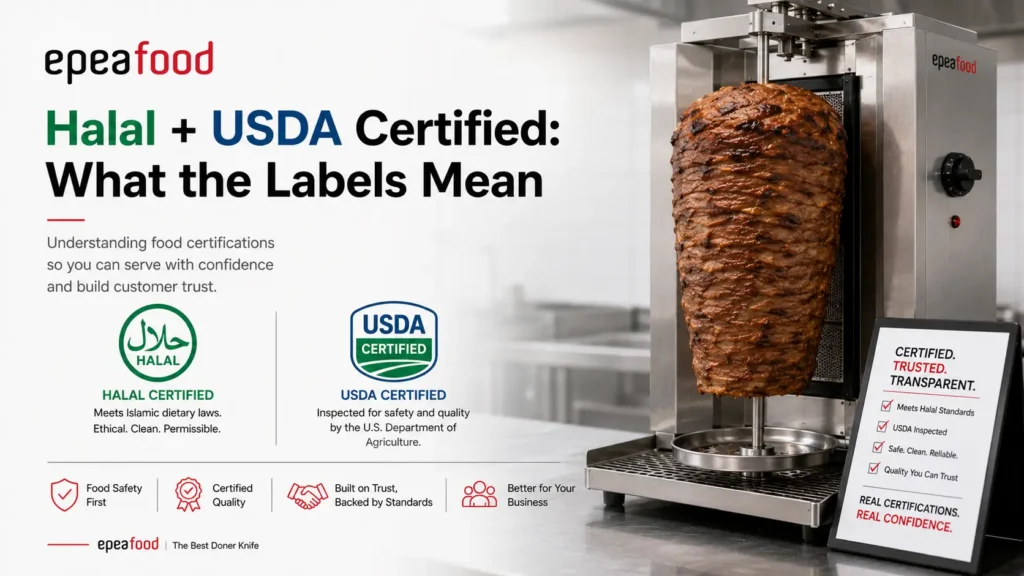
When a customer picks up a package of sliced protein or orders a plate of doner, the certification stamps on that product carry more weight than most operators realize. Halal and USDA labels are not marketing decoration. They are two separate promises about how the meat was sourced, handled, and inspected, and each one speaks to a different concern your customer walks in with.
Understanding what these two labels actually mean, and why seeing them together matters, helps you answer questions at the counter with confidence instead of guesswork. Here is a clear breakdown of what each certification covers, where they overlap, and how they shape the trust your customers place in your kitchen.
What Halal Certification Actually Guarantees
Halal is an Arabic term meaning permissible, and when it appears on meat, it points to a specific set of requirements rooted in Islamic dietary law. The animal must be healthy at the time of slaughter, the process must be carried out by a qualified individual, and a blessing is recited. Blood is fully drained, and the meat cannot come into contact with anything considered non-permissible, including pork or alcohol-based products.
For a customer who eats halal, this label is not a preference. It is a requirement they cannot compromise on. That is why a certifying body matters so much here. A legitimate halal certificate means an independent authority has audited the supply chain, verified the slaughter method, and confirmed that no cross-contamination occurred during processing and packaging.
What often gets missed is that halal covers the entire journey, not just the moment of slaughter. Equipment cleaning, storage separation, and even the seasonings used all fall under scrutiny. When you serve products from our doner kebab or shawarma lines carrying proper halal certification, you are telling a segment of your customers that their standards were respected at every stage.
What the USDA Stamp Adds to the Equation
The USDA mark answers a completely different question. Where halal speaks to religious permissibility, the USDA seal speaks to safety, sanitation, and honest labeling under United States federal law. A USDA inspection confirms that the facility met strict standards for hygiene, that the meat is free from disease, and that what the label says matches what is inside the package.
Here is what a USDA-inspected operation is signing off on:
- Continuous inspection of the facility by trained federal personnel, not a one-time visit
- Verification that the meat came from healthy animals processed under sanitary conditions
- Accurate labeling of species, weight, and ingredients with no misrepresentation
- Documented handling and temperature controls that reduce the risk of contamination
- Traceability, so a product can be tracked back through the supply chain if a problem ever arises
For your business, this is the layer that protects against foodborne risk and regulatory trouble. A customer may not know the technical details of the inspection process, but they recognize the stamp as a signal that a serious authority stands behind the product’s safety.
Why Both Labels Together Matter for Your Menu
Plenty of products carry one certification or the other. What sets a stronger supplier apart is carrying both. Think of them as answering two different worries at the same time. Halal reassures the customer that the food fits their faith. USDA reassures them that the food is clean, safe, and honestly represented.
A product that is halal but not USDA-inspected leaves a gap on safety oversight. A product that is USDA-inspected but not halal locks out an entire community of customers. When both stamps appear together, you remove the friction for a much wider audience, and you avoid the awkward moment of turning away a family because you cannot confirm one standard or the other.
This dual assurance becomes especially valuable if you run a mixed menu. A burger and kebab concept, for instance, serves customers with very different expectations at the same counter. Sourcing from a supplier who covers both certifications across the product range means you are not juggling separate vendors or explaining inconsistent standards.
What Your Customers See When They Read These Labels
Most people do not read certification documents. They read the front of the package, the sign on your wall, or the note on your menu, and they make a snap judgment about whether they can trust you. That judgment happens in seconds, and the labels do a lot of the talking before you say a word.
For a halal-observant customer, spotting a verified halal mark turns hesitation into relief. They have likely been let down before by vague claims that did not hold up. A clear, certified label tells them they can order without an uncomfortable conversation. For the safety-conscious customer, the USDA stamp works the same way, signaling that someone with authority checked the work.
There is also a quieter benefit that rarely gets discussed. When a customer sees both labels, they read professionalism into your whole operation. The assumption becomes that a business careful enough to secure proper certification is probably careful about everything else, from kitchen cleanliness to how the gyro is cooked. The labels borrow trust for the parts of your business they cannot see.
How Halal and USDA Standards Work Side by Side
A common misconception is that halal and USDA requirements pull in different directions. In practice, they run on parallel tracks that reinforce each other. A modern processing facility can absolutely satisfy both, and the best ones are built to do exactly that from the start.
The USDA framework governs the physical environment. It dictates sanitation schedules, temperature logs, inspection access, and labeling accuracy. The halal framework governs the sourcing and handling method, plus the separation of permissible from non-permissible products. Neither cancels the other out. A facility simply layers the halal protocol on top of an already USDA-compliant foundation.
Where operators sometimes get tripped up is cross-contamination during production runs. Handling both halal and non-halal lines under one roof demands strict separation of equipment, storage, and cleaning cycles. This is exactly where a specialized supplier earns its keep, because the discipline required is significant and the margin for error is small. Our sliced proteins are produced with that separation built into the workflow, not added as an afterthought.
Choosing Certified Products for Your Kitchen
Sourcing certified products sounds simple until you are standing in front of a dozen supplier options, all making similar claims. A little diligence here saves a lot of trouble later. The goal is to verify that the certification is real, current, and backed by a recognized body rather than a self-declared stamp.
Before you commit to a supplier, run through this checklist:
- Confirm the halal certificate names a recognized certifying authority, not just the manufacturer
- Check that the USDA establishment number is present and valid on the packaging
- Ask for documentation you can show customers if they request proof
- Verify that certifications are current, since they require periodic renewal
- Look for consistency across the full product line, not just one flagship item
- Confirm how the supplier separates halal and non-halal production to prevent cross-contamination
Getting these answers up front tells you whether you are dealing with a serious partner. A supplier who can produce clean documentation without hesitation is one you can build a menu around. If you want to talk through what certifications apply to specific products or the retail line, reaching out directly through our contact page is the fastest way to get clear answers.
Building Customer Trust Around Certification
Certification only pays off if your customers know about it. Too many operators secure proper labels and then hide them in a back office. The trust these standards create needs to be visible at the moment a customer is deciding whether to order.
Put the information where people look. A small, clear note on the menu, a sign at the counter, or a line on your website removes doubt before it forms. Train your staff to answer certification questions plainly, because a confident, honest answer at the register does more for loyalty than any promotion. When someone asks whether your meat is halal and your team responds without hesitation, that customer remembers it.
Over time, this builds a reputation that markets itself. Word travels fast within communities that eat halal, and a spot known for taking certification seriously becomes the default choice. In short, the labels are the starting point, but the trust they generate is what keeps people coming back. Sourcing from a certified partner like Egea Food gives you the foundation to make that promise and keep it.
Frequently Asked Questions
Does USDA certification mean a product is also halal?
No. These are two separate standards. USDA covers safety, sanitation, and accurate labeling, while halal covers religious permissibility and slaughter method. A product needs both certifications to satisfy both requirements.
Can one facility produce both halal and USDA-certified products?
Yes. A properly run facility layers halal protocols on top of a USDA-compliant foundation, using strict separation of equipment and cleaning cycles to prevent cross-contamination between halal and non-halal lines.
How can I prove to my customers that my products are certified?
Ask your supplier for current certification documents, including the halal certificate from a recognized body and the USDA establishment number. Keep copies you can show at the counter if a customer asks.
Do halal certifications expire?
Yes. Halal certifications require periodic renewal and audits. Always confirm the certificate is current rather than assuming a past certification still applies.
Why should I source products carrying both labels instead of one?
Carrying both removes friction for a wider audience. You reassure halal-observant customers on faith and safety-conscious customers on hygiene at the same time, without turning anyone away or juggling multiple suppliers.