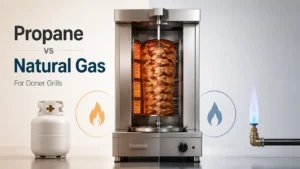
A commercial doner kebab machine is one of the largest equipment investments for any kebab shop, restaurant, or food truck, and starting prices typically begin around $800–$1,200 for entry-level electric units and can exceed $6,000 for high-capacity premium models. The final cost depends on the fuel type, burner configuration, meat capacity, build materials, and the brand you choose. Understanding how these factors shape the price helps operators budget accurately and avoid paying for features they won’t use, or worse, underspending on a machine that can’t handle daily volume.
Average Price Ranges for Commercial Doner Machines
Commercial doner machines sit in a wide pricing spectrum because the category covers everything from compact countertop units designed for low-volume operations to heavy-duty floor-standing models built for high-traffic kebab shops. Entry-level electric machines with a single heating zone generally start in the $800–$1,500 range, making them suitable for small cafés, food trucks, or businesses testing the kebab market before scaling up. These models usually accommodate around 20–30 kilograms of meat and offer basic temperature control without advanced features.
Mid-range commercial machines typically fall between $1,800 and $3,500. At this tier, you’ll find sturdier stainless-steel construction, multiple burners or heating elements, adjustable vertical positioning, and better insulation for energy efficiency. Most established kebab shops operate within this price bracket because it balances durability with reasonable upfront cost.
High-capacity and premium machines begin around $4,000 and can reach $6,000 or more, especially when sourced from well-known European or Turkish manufacturers. These units are engineered for continuous daily use, handle 60–120 kilograms of meat, and often include advanced features like rotisserie speed control, heat zoning, and commercial-grade motors designed to run for years without failure.
Gas vs. Electric Models: Cost and Efficiency Compared

The choice between gas and electric doner machines significantly affects both the purchase price and long-term operational costs. Gas-powered models, which use either LPG or natural gas, generally start around $900–$1,400 for basic units and can climb to $4,500 for multi-burner commercial models. Gas machines heat faster, reach higher surface temperatures, and deliver the charred exterior that traditional kebab preparation demands, which is why many established kebab shops prefer them.
Electric doner machines usually start at slightly higher price points, with entry-level commercial units beginning around $1,000–$1,600. However, they tend to have lower installation costs because they don’t require gas line connections or specialized ventilation in some jurisdictions. Electric models offer more precise temperature control, making them easier for less experienced operators to manage, and they’re often the only option permitted in food courts, shopping centers, and indoor venues with strict fire codes.
Operational efficiency is where the real cost difference emerges. Gas units typically cost less to run per hour in regions with affordable natural gas, while electric models can become expensive in areas with high electricity rates. On the other hand, electric machines require less maintenance since they have fewer mechanical components prone to wear, no burner cleaning, and no ignition system issues. Over a five-year period, the total cost of ownership often balances out, meaning the decision should prioritize your kitchen setup, local energy prices, and ventilation capabilities rather than upfront savings alone.
How Burner Count and Meat Capacity Affect the Price
Burner count is one of the most direct factors influencing a commercial doner machine’s price, because each additional heating element adds to both manufacturing complexity and operational capability. Single-burner machines are the most affordable, typically starting around $800–$1,300, and are best suited for breakfast cafés or small operations serving under 50 portions per day. They heat a limited surface area, which restricts how quickly meat can be cooked and served during peak hours.
Two-burner models, which dominate the mid-range market, generally cost between $1,500 and $2,800. The second burner allows more even heating across a taller meat stack and shortens the time between cooking cycles, making these units practical for most full-service kebab shops. Three- and four-burner machines, priced from around $2,800 up to $5,500, are built for high-volume kitchens that serve hundreds of portions daily and need to keep large quantities of meat at optimal serving temperature throughout a busy shift.
Meat capacity scales alongside burner configuration but also depends on spit length and motor strength. Smaller machines handle 20–40 kilograms, mid-tier units manage 50–80 kilograms, and heavy-duty commercial spits can support 100–150 kilograms of stacked meat. Larger capacity means a stronger motor, reinforced spit rod, and heavier base, all of which add material costs that get reflected in the final price.
A common mistake operators make is buying based on current volume rather than projected growth. Upgrading machines later is expensive and disruptive, so sizing up by one tier at purchase often saves money over a two- to three-year horizon.
Should You Buy a New or Used Doner Machine?
The decision between a new and used doner machine depends on budget flexibility, risk tolerance, and the condition of available secondhand units. New machines carry manufacturer warranties, typically ranging from one to three years, and come with undamaged motors, burners, and frames that should deliver years of reliable service. For a new mid-range commercial unit, you’ll generally pay $1,800 to $3,500, with premium models going considerably higher.
Used doner machines can be found for 40–60% less than comparable new units, which is tempting for new businesses working with tight capital. A well-maintained two-year-old commercial machine from a reputable brand can still perform excellently for another five to seven years. Restaurant liquidations, closing businesses, and equipment dealers specializing in used commercial kitchen gear are the most common sources, with prices typically starting around $700–$1,800 depending on age and condition.
The main advantages and disadvantages break down as follows:
- New machine advantages: Full warranty coverage, latest energy-efficiency features, predictable lifespan, and financing options that spread cost over 24–60 months. Installation support is usually included, and spare parts are easy to source directly from the manufacturer.
- Used machine advantages: Significantly lower upfront cost, immediate availability without shipping delays, and depreciation already absorbed by the previous owner. A used machine can free up capital for inventory, marketing, or staffing in the critical early months of a business.
- New machine drawbacks: Higher initial cost, longer lead times on imported models, and the reality that a new machine loses 20–30% of its value within the first year of use.
- Used machine drawbacks: No warranty in most cases, unknown maintenance history, potential for hidden mechanical wear, and limited recourse if the unit fails shortly after purchase. Motor replacement alone can cost $400–$900, which erodes the savings from buying used.
For operators with limited technical knowledge, buying new from an authorized dealer is usually the safer path. Experienced restaurateurs who can inspect equipment properly and handle minor repairs often find excellent value in the used market.
Hidden Costs: Installation, Accessories, and Maintenance
The sticker price of a commercial doner machine rarely reflects what you’ll actually spend to get it operational. Installation is the first major hidden cost, particularly for gas models that require professional plumbing, certified gas line connections, and sometimes upgraded ventilation hoods to meet local fire and safety codes. Installation fees typically start around $200–$400 for electric units and can reach $800–$1,500 for gas machines requiring new infrastructure.
Accessories add another layer of expense that many first-time buyers overlook. A proper commercial setup requires drip trays, additional spit rods for batch preparation, heat shields, knife sharpeners or electric kebab slicers, and often a dedicated prep table with refrigerated storage. Electric kebab knives alone start around $150–$300, and a second spit rod for rotating meat batches costs $80–$200 depending on length. These accessories aren’t optional in a professional kitchen because they directly affect service speed and food safety.
Routine maintenance represents the ongoing cost that determines a machine’s true lifetime value. Burner cleaning, motor inspection, belt or chain replacement, and thermostat calibration should happen at least twice a year in a high-volume kitchen. Annual maintenance costs typically range from $150 to $500, with more intensive repairs like motor replacement, burner rebuilds, or electronic control board issues pushing single-incident costs into the $400–$1,200 range. Keeping a small reserve for unexpected repairs prevents downtime during peak service periods, when an out-of-service doner machine can cost thousands in lost revenue over a single weekend.
Utility costs also shouldn’t be ignored. A commercial doner machine running eight hours daily can add $80–$250 per month to energy bills, and this figure fluctuates based on local rates, burner efficiency, and how long the machine stays hot between service periods.
Are Premium Brand Machines Worth the Extra Cost?
Premium brand doner machines, often manufactured in Turkey, Germany, or Italy, command prices that can be 30–70% higher than generic alternatives, and the question of whether they justify the premium comes down to how the machine will be used. Established manufacturers build with thicker stainless steel, use industrial-grade motors rated for continuous daily operation, and engineer components to tolerances that generic factories simply don’t match. For a kebab shop running twelve-hour shifts seven days a week, this engineering difference translates directly into fewer breakdowns and longer service life.
The value proposition of premium machines becomes clearer when you calculate cost per operational year. A $4,500 premium unit that reliably runs for ten years works out to $450 annually, while a $1,800 generic unit that needs replacement after four years costs $450 annually as well, before accounting for repair costs and service disruptions along the way. Premium brands also maintain better resale value, so if the business pivots or closes, recovering 40–50% of the purchase price is realistic for well-maintained units from recognized manufacturers.
Parts availability is another practical advantage that’s easy to underestimate until something breaks. Premium brands maintain supply networks, authorized service technicians, and readily available spare parts across major markets, meaning a failed motor or thermostat can usually be replaced within days. Generic machines sourced through less established channels sometimes leave operators waiting weeks for parts or forced to improvise with incompatible components that shorten the machine’s remaining lifespan.
Key factors that justify the premium brand investment include:
- Construction quality: Thicker gauge stainless steel, reinforced welds, precision-machined spit rods, and heat-resistant components that don’t warp after repeated cycles. These machines feel noticeably heavier and more solid than budget alternatives.
- Motor reliability: Commercial-grade motors rated for 15,000+ operational hours, often with sealed bearings and thermal protection that prevents burnout during long shifts.
- Heating efficiency: Better-designed burners or heating elements that distribute heat evenly across the meat surface, reducing cooking time and producing more consistent results that customers notice.
- After-sales support: Access to trained technicians, documented repair procedures, warranty coverage that’s actually honored, and direct communication with manufacturer representatives when problems arise.
- Compliance and certification: Premium manufacturers typically certify their machines to EU, NSF, or equivalent international safety and hygiene standards, which matters for insurance, health inspections, and franchise requirements.
For low-volume operations serving fewer than 50 portions daily, a well-built mid-range machine often delivers sufficient performance without the premium price. For established or high-volume kebab businesses where every hour of downtime means lost revenue, premium machines consistently justify their higher cost through reliability, longevity, and operational consistency that generic alternatives struggle to match.