The price of a commercial doner kebab machine in 2026 ranges from around $150 for small countertop units to over $5,000 for heavy-duty 5 or 6 burner industrial models. Most kebab shop owners spend between $800 and $2,500 for a reliable, mid-tier machine that can handle daily restaurant volume. The final figure depends on burner count, capacity, fuel type, brand reputation and whether you go new or used. In this guide, you will find a clear breakdown of every cost factor that shapes the real price you will pay.
Current Market Prices for Different Machine Sizes
Machine size is the single biggest driver of price, and the market in 2026 is clearly divided into capacity tiers. Small countertop machines with 2 burners and a 10 to 15 kg meat capacity sit at the entry level, usually priced between $150 and $400. These are common in food trucks, small takeaways and household kitchens where space and output are limited.
Mid-size machines step things up considerably. A 3 burner unit with a 30 to 50 kg capacity typically costs between $700 and $1,800 in 2026, depending on the country you buy from. This is the size most independent kebab shops choose because it offers a balanced output for lunch and dinner rushes without consuming too much energy or floor space.
When you move into the 4 burner category with 70 to 100 kg capacity, prices start climbing toward $1,800 and $3,200. These machines are built for busy restaurants serving hundreds of portions daily and usually come with stronger motors, thicker stainless steel and better insulation. The build quality difference compared to entry-level models is noticeable even at first touch.
For high-volume operations such as catering companies, large kebab chains or industrial kitchens, 5 and 6 burner machines holding 120 to 200 kg of meat dominate the upper market. Prices in this segment generally fall between $3,500 and $6,500. Some specialty models with lava stone heating or hybrid features can push beyond that range, especially when ordered from premium European manufacturers.
Authentic Turkish Doner & Equipment Delivered Worldwide
Ready-made Turkish doner and professional doner equipment shipped quickly to your home, workplace, or restaurant. Quality and tradition in every delivery.
Gas vs. Electric: Which One Is More Cost-Effective?
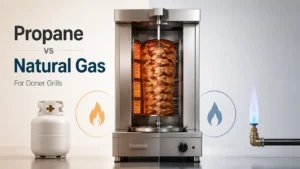
The fuel type debate is one of the most important decisions any buyer faces, and it directly affects both the upfront price and the long-term operating cost. Gas machines, whether running on natural gas or LPG, are usually 10 to 20 percent cheaper to buy than their electric counterparts of equivalent size. They also heat up faster and reach higher temperatures, which is why most professional kebab shops still prefer them.
Electric machines, on the other hand, carry a higher initial price tag because of their built-in heating elements, temperature controls and electrical safety components. A 3 burner electric model typically costs around $200 to $500 more than its gas equivalent. However, they shine in locations where gas installation is restricted, such as shopping mall food courts, indoor venues without proper ventilation or rented spaces with strict regulations.
Operating costs tell a different story depending on your region. In countries where natural gas prices are low, gas machines win on monthly fuel bills by a wide margin. In areas where electricity is cheaper or subsidized, electric models can match or even beat gas in long-term cost. You should always check local utility rates before deciding because the wrong choice can quietly drain thousands from your annual budget.
There is also a practical maintenance angle to consider. Gas burners and infrared ceramic elements need periodic cleaning and occasional replacement, especially in hard-water areas where mineral buildup is a problem. Electric heating elements last longer on average but are more expensive to replace when they finally fail. For most kebab shop owners, gas remains the most cost-effective option overall, but electric is gaining ground fast in urban locations.
Why Brand and Build Quality Matter for the Price
Two machines with the same number of burners and the same capacity can have wildly different price tags, and brand is usually the reason. Established Turkish manufacturers like Inoksan, Empero and Beckers have built their reputation on industrial-grade stainless steel, precision-engineered motors and components that survive years of daily punishment. Their machines often cost 30 to 50 percent more than generic alternatives, but the lifespan difference justifies that gap.
Build quality shows up in places most buyers overlook. The thickness of the stainless steel body, the gauge of the meat spit, the quality of the bearings inside the rotation mechanism and the type of insulation behind the burner plates all influence both performance and durability. Cheaper machines tend to use thinner metal that warps under prolonged heat, leading to uneven cooking and a shorter usable life.
The motor is another silent cost factor. A premium machine uses a heavy-duty industrial motor designed to rotate fully loaded spits for hours without overheating. Budget machines often rely on lighter motors that struggle once you load 40 kg of meat and start failing within the first year. Replacing a motor on a cheap machine can cost almost as much as buying a new entry-level unit, which is why paying more upfront often saves money in the long run.
Reputable brands also offer better warranty coverage, easier access to spare parts and faster technical support. When a burner goes out on a Friday evening rush, getting a replacement part within 24 hours can save your entire weekend revenue. That kind of service network is rarely available with the cheapest options on the market, and it is often invisible until you need it.
Buying New vs. Used: What Should You Consider?
Buying used can cut your kebab machine cost by 40 to 60 percent, which is a serious saving for anyone starting a new shop on a tight budget. A 3 burner machine that retails new for $1,500 can often be found in good second-hand condition for $600 to $900. The catch is that the used market for commercial kitchen equipment is full of machines that have been worked hard, and visible wear rarely tells the full story.
When you inspect a used machine, the burners deserve your closest attention. Check whether the flames burn evenly across all sections, look for cracked ceramic plates or corroded gas lines, and listen to the motor while it rotates a loaded spit. A motor that hums loudly or struggles under weight is on its way out and will cost you several hundred dollars to replace within months.
There are situations where buying used genuinely makes sense. If you are testing a new menu concept, opening a seasonal location or running a low-volume operation, a refurbished machine from a reputable dealer with a short warranty can be an excellent middle ground. Some dealers offer 30 to 90 day guarantees on refurbished units, which protects you from the most common hidden defects.
New machines remove most of the uncertainty. You get full warranty coverage, the latest safety certifications, fresh burners and a verified service history of zero hours. For a business that depends on the machine running every single day, the predictability of new equipment is often worth the premium. The decision ultimately comes down to your cash flow, your daily volume and your appetite for risk.
Hidden Costs You Need to Factor Into Your Budget
The sticker price is rarely what you actually pay. Shipping is the first surprise for most buyers, especially when ordering a heavy stainless steel machine. Domestic delivery can add $100 to $400, while international freight from Turkey, China or Europe routinely adds $300 to $1,200 depending on destination and customs handling. Buyers often forget to ask about this before committing.
Installation is another cost that sneaks up on first-time owners. Gas machines require a certified gas connection, and electric models with high wattage often need a dedicated power line. Depending on your kitchen layout and local regulations, professional installation can run anywhere from $150 to $600. Some suppliers include basic setup in the price, but most do not.
There are also several smaller expenses that add up quickly:
- Extra meat spits and skewers for rotation during cleaning, usually $40 to $120 each
- A proper kebab knife or electric slicer, ranging from $80 for manual blades to $400 for electric models
- A meat catcher tray or grease drip pan if not included with the machine
- Ventilation hood upgrades to meet fire safety codes, often $500 to $2,000
- Initial gas regulator, hose and safety valve, typically $50 to $150
- Cleaning supplies designed for stainless steel and burner ceramics
- Import duties and VAT depending on your country, sometimes 10 to 25 percent on top of the purchase price
Insurance and safety certification can also become a cost. Many municipalities require commercial cooking equipment to carry specific certifications such as CE, ETL or NSF marks. If your machine does not have the right certification for your region, you may face fines or be forced to replace it entirely. Always confirm the paperwork before paying.
How Much Should You Spend on a Starter Machine?
For someone opening their first kebab shop, the sweet spot is usually a 3 burner gas machine in the $900 to $1,500 range. This budget gets you a properly built stainless steel unit with enough capacity to serve 100 to 200 portions a day, which covers the realistic volume of most new businesses during their first year of operation.
Spending less than $700 on your first commercial machine is risky unless you are running a very small operation or testing a pop-up concept. The cheapest models often look similar in photos but use thinner metal, weaker motors and lower-grade burners. The savings disappear the first time you need a repair or experience downtime during a busy evening.
If you have the budget, stretching to $2,000 buys noticeable upgrades. You move into territory where established brands offer entry-level professional models with better insulation, more even heat distribution and components that are designed to be repaired rather than replaced. For a business you plan to run for five or more years, this tier offers the best long-term value.
Avoid the temptation to buy your dream machine on day one. Many successful kebab shop owners start with a solid mid-range model, learn their actual daily volume over six to twelve months, and then upgrade based on real data rather than guesses. Overbuying capacity in the beginning ties up cash that could go toward marketing, staff training or rent during the critical first year.
Maintenance and Repair: Long-Term Ownership Costs
A commercial doner kebab machine is not a one-time purchase, it is an ongoing investment. Daily cleaning is the foundation of low maintenance costs. Grease buildup on burners and inside the rotation mechanism is the leading cause of premature motor failure and uneven cooking. Cleaning supplies and degreasers typically cost $30 to $80 per month for a busy shop.
Burners and ceramic plates are the components you will replace most often. On a heavily used machine, individual ceramic plates may need replacement every 12 to 24 months, costing $25 to $80 each. Gas valves, regulators and ignition components also wear out gradually and usually need attention every two to three years, with parts ranging from $40 to $200.
The motor is the most expensive single repair you are likely to face. A quality replacement motor for a mid-range machine runs between $150 and $400, plus labor if you cannot install it yourself. With proper care, a good motor lasts five to seven years, but neglect can cut that lifespan in half. Annual professional servicing, usually $80 to $200, is the single best investment for extending motor life.
Energy costs are the largest long-term expense by a wide margin. A 3 burner gas machine running 8 hours a day can easily consume $150 to $400 worth of fuel per month depending on local prices. Tracking your gas or electricity bills carefully during the first six months gives you a realistic picture of true operating cost and helps you price your menu correctly.
Finally, set aside roughly 5 to 8 percent of your machine’s original price each year as a maintenance reserve. For a $2,000 machine, that means putting $100 to $160 aside annually. This buffer covers routine parts, unexpected repairs and eventual upgrades without disrupting your cash flow. Owners who plan for these costs from day one rarely face the painful surprise of a machine that suddenly stops working in the middle of a profitable month.