Choosing the right size doner machine comes down to one simple equation: how much meat you plan to cook in a single shift versus how fast your customers buy it. Most operators get this wrong in their first year, either oversizing and burning energy on a half-empty spit, or undersizing and losing sales during the lunch rush. This guide breaks down the practical capacity numbers, burner configurations, and business types so you can match a machine to your actual demand instead of guessing.
How Many Portions Can You Get Per Kilo of Meat?
A kilogram of raw stacked doner meat yields between 8 and 12 standard portions once cooked. The variation depends on the moisture loss during cooking, the fat content of the meat, and how thin your cutter shaves the surface. Beef and lamb stacks tend to sit on the lower end of that range because they lose more water, while chicken doner often gives you closer to 12 servings per kilo thanks to its denser texture.
If you serve generous portions, like a 180 to 200 gram wrap or plate, expect around 7 or 8 portions per kilo. A standard street-food size of 130 to 150 grams gets you the 10 portion average that most operators plan around. Smaller pita or appetizer sizes can stretch a kilo to 14 servings, though this is rare outside of catering setups.
The math matters because it directly tells you what machine size to buy. If you forecast 200 servings per day and you serve 150 gram portions, you need roughly 25 to 30 kilos of meat capacity ready before lunch. That single calculation eliminates half the machines on the market for your specific case.
One thing worth mentioning: the first few slices off a fresh stack are usually thicker and drier than the rest. Experienced cooks waste less here, but a new cook can lose two or three portions per kilo just from technique. Factor this in if you are training staff.
Matching Machine Capacity to Your Daily Customer Volume
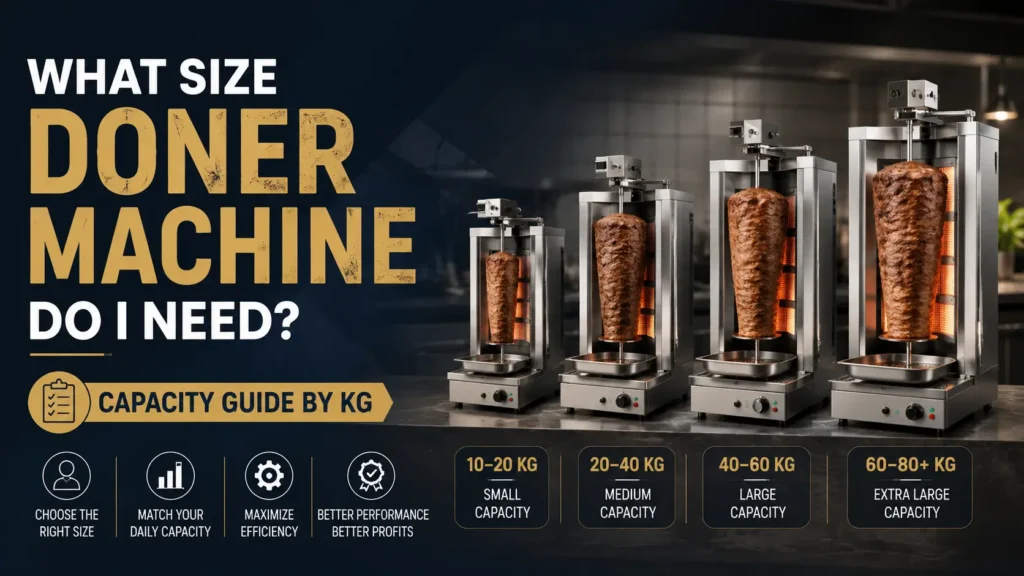
Doner machines are sold by their meat stack capacity, typically ranging from 15 kg at the smallest end up to 120 kg for industrial units. The right size for you is not the maximum you could ever sell, but the realistic amount you will actually move in one day without leftover meat sitting overnight.
For a business serving 50 to 100 customers per day, a 20 to 30 kg machine is the sweet spot. This covers your lunch peak with enough buffer for unexpected traffic, and the stack stays fresh because you are turning it over completely within service hours. Anything larger at this volume means you are cooking meat that will not be sold at peak quality.
Mid-volume operations doing 150 to 300 customers daily should look at 40 to 60 kg machines. At this scale you usually need two stacks running, one prepared earlier and one started mid-shift, so a single larger machine or two smaller ones become a real planning decision. Many owners prefer two 30 kg units over a single 60 kg machine because if one breaks, service does not stop completely.
High-volume restaurants pushing 400 customers a day and above need 80 kg machines or larger, and almost always run multiple units in parallel. The capacity question here shifts from how big to how many, because a single oversized stack becomes hard to cook evenly and slower to replace if it runs out.
How Many Burners Do You Actually Need?
The number of burners on a doner machine controls cooking speed and stack size more than almost any other feature. Most commercial machines come with 3, 4, 5, 7, or 8 burners arranged vertically, and each burner heats roughly 10 to 12 cm of stack height. The taller your meat column, the more burners you need to cook it evenly from top to bottom.
A 3 burner machine handles stacks up to about 20 kg and is the standard choice for cafes, food trucks, and small takeaway spots. The footprint is compact and the gas consumption stays low, which matters when you are running on a single bottle or limited connection.
4 and 5 burner machines fit the 30 to 50 kg range and represent the most common purchase for established restaurants. They give you flexibility to run a smaller stack on slow days by lighting only the lower burners, then add height and capacity for busy services. This adjustability often gets overlooked when people focus only on maximum capacity.
7 and 8 burner machines exist for stacks of 70 kg and above. They draw significantly more gas, need stronger ventilation, and require a cook who knows how to manage uneven heating across a tall column. Unless you genuinely move that volume, the extra burners just cost you fuel without adding revenue.
Ideal Doner Machine Sizes for Food Trucks and Small Cafes
Food trucks and small cafes share two constraints that bigger restaurants do not face: limited space and limited power. Your machine choice has to respect both, even if it means accepting a smaller meat capacity than you might prefer.
For most food trucks, the practical range sits between 15 and 25 kg with 3 burners. This size fits standard truck counter depths, runs on LPG without needing an industrial gas line, and produces enough doner for a typical service window of 4 to 6 hours. The compact footprint also leaves room for prep surface and a cutter, which matters more than people realize until they try to work in a cramped setup.
Here are the practical features that genuinely matter for small mobile or compact operations:
- Stack capacity between 15 and 25 kg to match a single service period without overcooking leftover meat
- 3 burner configuration that runs efficiently on standard LPG bottles instead of demanding heavy gas supply
- Stainless steel body with removable drip tray because cleaning in a tight space is non negotiable
- Adjustable spit speed so you can slow rotation during slow periods and save fuel
- Width under 45 cm to fit standard food truck and cafe counter layouts
- Total power draw the electrical motor pulls under 100 watts to avoid tripping shared circuits in older buildings
Small cafes with seated customers can go slightly larger, up to 30 kg, because they usually have a fixed kitchen with proper ventilation. The decision often comes down to whether you serve doner as a main feature or as one item among many. If it is just one of ten menu items, stay at 20 kg and protect your margins. If it is the headline dish, the 30 kg machine pays for itself within months through higher peak-hour throughput.
Heavy-Duty Machines for High-Volume Restaurants
Restaurants that build their menu around doner, or serve it as a primary feature in a high-traffic location, need machines designed for sustained heavy use rather than peak occasional bursts. The difference is not just size, but build quality, burner output per kilo, and the speed at which the unit can recover heat when fresh meat is loaded mid-service.
A genuine heavy-duty machine in the 60 to 100 kg range uses thicker stainless steel, infrared or ceramic burner panels instead of basic open flame, and a motor rated for 12 plus hours of continuous rotation. Cheaper machines in similar capacities exist, but they fail within two years under restaurant conditions because their components are sized for occasional rather than constant use.
Below is a quick reference for what to look for at each high-volume tier:
- 60 to 70 kg machines suit restaurants doing 300 to 450 covers per day with 5 burners and dual stack option for switching meats
- 80 to 90 kg machines fit operations serving 500 to 700 customers daily with 7 burners and reinforced spit shaft for the extra weight
- 100 kg and above machines are reserved for industrial kitchens, large chains, and high-traffic locations doing 800 plus servings with 8 burners and three-phase electrical requirements
- Dual stack configurations let you run beef and chicken side by side, which most busy operators end up needing within their first year
- Infrared ceramic panels instead of open flame because they deliver more even heat across tall stacks and use about 20 percent less gas at the same output
- Sealed motor units rated above 150 watts to handle the load of full stacks without burning out during long services
One often overlooked factor at this level is ventilation. A 90 kg machine generates serious heat and grease vapor, and your extraction system needs to match. Many restaurants buy the right machine and then struggle because their hood and ductwork were sized for a 30 kg unit.
Does the Type of Meat Affect the Size You Need?
Meat type changes the equation more than most buyers expect. Chicken, beef, lamb, and mixed stacks each behave differently in terms of cooking time, fat rendering, and the weight a spit can safely carry, and these differences influence which machine size actually fits your menu.
Chicken doner cooks fastest and loses the least weight during cooking. A 30 kg chicken stack will be ready to slice within 35 to 45 minutes of lighting the burners, which makes smaller machines viable even at higher customer volumes. Operators serving primarily chicken can often work with a 25 kg machine and refill it once during the day, instead of jumping to a 50 kg unit.
Beef and lamb stacks are denser, hold more moisture, and take significantly longer to reach proper internal temperature. A 30 kg beef stack typically needs 60 to 75 minutes before slicing can begin, and the meat continues developing flavor as it cooks down. This means red meat operators often need slightly more total capacity than their portion math suggests, because part of the stack is always still cooking and not yet sliceable.
Mixed stacks of beef and lamb, which is the traditional Turkish style, sit in the middle for cooking time but require closer attention to fat balance. The fat content directly affects how dry or juicy the final shavings are, and a stack that is too lean on a small machine will give you tough portions on the second half of service. This is why some operators size up slightly when running traditional mixed meat, even if their customer numbers would suggest a smaller unit.
There is also a structural point worth knowing. The spit shaft on small machines is rated for a maximum weight, typically marked by the manufacturer. Pushing a 25 kg machine with a 30 kg dense beef stack bends the shaft over time, and the repair often costs more than the difference in price between sizes. Match the machine to the heaviest realistic load, not the average.
Should You Buy a Bigger Machine Just in Case?
The instinct to oversize is strong, especially for first-time buyers who imagine the queues forming once their restaurant opens. In practice, buying a bigger machine just in case usually costs more than it saves, and the reasons go beyond the upfront price tag.
A larger machine running a half-full stack cooks unevenly. The unused burners either stay off, leaving cold zones that affect the rest of the column, or stay lit and waste gas heating empty air. Either way, the meat quality suffers and your operating costs go up without any matching revenue. Most operators who oversize end up running smaller stacks anyway and wonder why their food cost percentage looks worse than competitors with smaller machines.
There is also a real maintenance and cleaning argument. A 60 kg machine takes nearly twice as long to clean at the end of service as a 30 kg unit, and that time adds up across a year. Staff cost, water, and chemical consumption all scale with machine size. If you are not using the capacity, you are paying for it every single night during closedown.
The smarter approach is to size for your realistic 12 month projection, not your three year dream. If demand grows beyond your current machine, you can add a second unit and run them in parallel, which actually performs better than one giant machine because you can run different meats or save energy by lighting only one stack during slow periods. Most successful doner operators end up with two medium machines rather than one large one, and they reach that setup gradually rather than buying it upfront.
The only legitimate case for sizing up is when your space, ventilation, and gas infrastructure cannot easily be upgraded later. If retrofitting the kitchen would be expensive or impossible, buying slightly larger upfront makes sense because it protects future flexibility. Outside of that specific scenario, match the machine to today’s volume and let growth pay for the next unit.