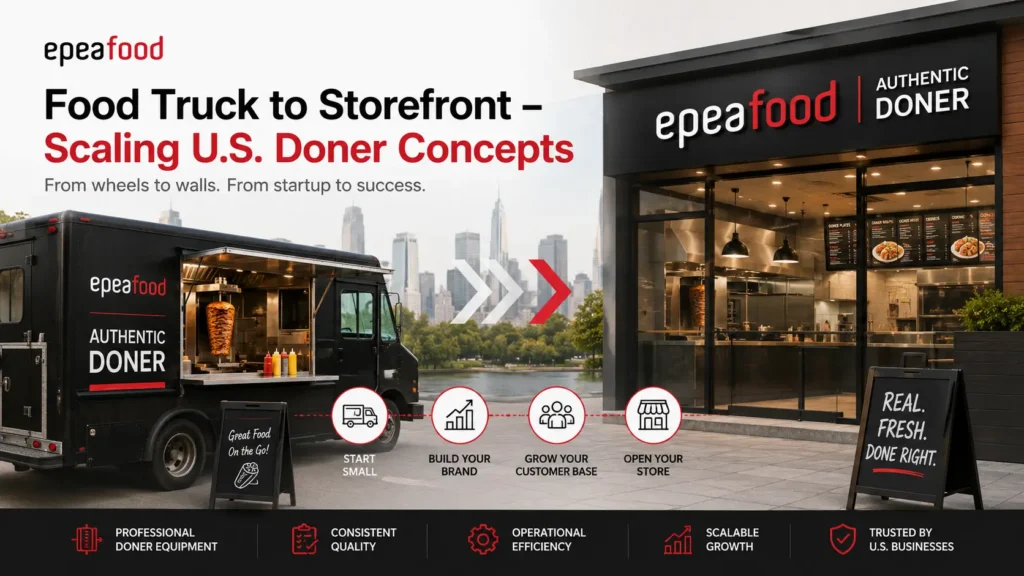
The jump from a doner food truck to a permanent storefront is one of the biggest calls a street food operator ever makes. It reshapes your costs, your daily routine, and the way customers find you. Handled well, it turns a busy corner into a brand people build their week around.
Plenty of trucks stall right at this stage. They have the lines, the five star reviews, and the regulars who know the crew by name, yet the leap to four walls still feels risky and heavy on cash. The reassuring part is that a doner concept is one of the friendliest street formats to scale, because the product and prep already run on a system a fixed kitchen can only sharpen.
What follows breaks down what genuinely changes once you sign a lease, from equipment and staffing to sourcing protein at higher volume. It is written for operators who already know their food sells and now want to grow without watering down what made the truck special.
If that move is on your mind this year, the sections below turn the process into steps you can start acting on this quarter, not theory you file away for later.
Why a Doner Concept Scales Better Than Most Street Food
Most street formats fight the same enemy when they grow: inconsistency. A burger flipper who nails it on a slow Tuesday can fall apart during a Friday rush. Doner sidesteps a lot of that. The doner kebab format is built on a vertical cone that cooks slowly and steadily, so the meat is essentially prepped once and served all day. That single trait is what makes it travel so cleanly from a small truck window to a full storefront kitchen.
Waste tends to stay low too. Because you shave to order, you are not throwing out trays of pre cooked protein at closing time. That matters even more at a storefront, where rent and utilities are watching every dollar. A tight food cost that worked on wheels usually gets tighter, not looser, once you have the space to store and manage inventory properly.
There is also the speed factor. A trained cook can plate a wrap or a plate in under a minute during peak hours, which keeps throughput high without cutting corners on quality. When you move into a building with tables, that same speed lets you serve dine in guests and a takeout line at once, something a truck window simply cannot handle.
Reading the Signs That You’re Ready to Sign a Lease
There is no magic revenue number that tells you the moment has come, but there are patterns worth trusting. Most operators feel the pull long before they admit it, usually when the truck starts turning away business it used to catch. The trick is separating a good month from a real, repeatable trend.
Before you commit to a five year lease, look for these signals showing up consistently, not just once:
- You sell out or hit your prep ceiling on multiple days a week, and it is a supply problem, not a slow day.
- Regulars keep asking where they can sit, order delivery, or bring a group of eight.
- Catering and large orders come in faster than the truck can fulfill them.
- Your brand gets recognized off the truck, in comments, tags, and word of mouth.
- Your food cost and labor are stable enough that you can forecast a month with confidence.
- You have saved or secured funding for at least six months of storefront overhead, not just the buildout.
If most of that list describes your current reality, the risk of staying small starts to outweigh the risk of growing. A truck that is constantly maxed out is leaving money on the table every week, and that lost revenue is often larger than the added cost of rent.
One caution worth naming: a viral moment is not the same as a durable trend. Give any spike a few months to settle before you treat it as your new baseline. Storefronts are unforgiving of demand that fades.
Building the Menu for a Bigger Kitchen
A truck menu is short by necessity. You have one flat top, limited storage, and a window the size of a laptop. A storefront lifts those limits, and the temptation is to add everything at once. Resist it. The smartest expansions keep the doner cone as the anchor and grow outward from proteins you already know how to run.
The easiest additions are variations on what already sells. If your beef and lamb cone is the star, a chicken cone or a second flavor profile gives regulars a reason to return without doubling your prep complexity. From there, formats like a gyro plate or a shawarma wrap let you speak to guests who search for those names specifically, even though the cooking method overlaps heavily with what you already do.
Sides are where storefronts quietly make their margin. Fries, rice bowls, salads, and house sauces cost little to produce and lift the average ticket in a way the meat alone cannot. A truck rarely has room for a full sides program, so this is often the single biggest revenue change after moving indoors.
Keep the menu tight enough that a new hire can learn it in a shift. Every extra item you add is another thing that can be out of stock, cooked wrong, or slow to plate during a rush. A focused menu built on sliced proteins you trust will always beat a sprawling one you cannot execute cleanly.
Equipment and Layout for a Fixed Location
The gear that fit your truck will not carry a storefront on its own. A fixed kitchen serves more covers, runs longer hours, and has to pass a stricter inspection, so the equipment list grows accordingly. The good news is you can plan most of it before you ever pick up a wrench, which keeps the buildout from spiraling.
Here is a practical starting checklist for a doner focused storefront kitchen:
- A commercial vertical broiler sized for your volume, ideally with the capacity to run two cones during peak hours. You can compare formats through doner kebab equipment built for continuous service.
- Adequate refrigeration and freezer space, since storefront inventory turns are larger and health codes are stricter than truck rules.
- A prep line with dedicated cutting, holding, and assembly zones so orders do not bottleneck at one station.
- Proper ventilation and a hood system rated for your broiler, which is often the single largest permit hurdle.
- Warewashing, a mop sink, and handwashing stations positioned to satisfy local code the first time.
- Point of sale hardware built for both dine in and takeout, plus a screen or system for delivery tickets.
Layout matters as much as the machines. Design the flow so raw prep, cooking, and pickup do not cross paths, both for food safety and for speed. A cook should be able to shave, plate, and hand off without walking around a colleague. Small inefficiencies that were tolerable in a cramped truck become expensive when you repeat them a few hundred times a day.
Buy for the volume you expect in a year, not the volume you have on opening day. Undersized equipment is the most common regret operators mention, because replacing a broiler after the walls are built is far more painful than sizing up at the start.
Keeping Your Protein Consistent at Higher Volume
Consistency is the promise that keeps regulars coming back, and it gets harder to protect as volume climbs. On a truck you might portion and season everything yourself, close to the pan. In a storefront running triple the covers, that hands on control has to be replaced by a reliable supply chain and a repeatable spec, or quality drifts without anyone noticing until reviews start slipping.
This is the point where many growing operators shift from building cones by hand to sourcing pre made, spec consistent cones. A steady supply of ready products frees your team to focus on service and sides rather than spending the first hours of every day stacking meat. It also flattens the quality curve, since each cone arrives to the same standard whether it is a Monday or a holiday weekend.
Volume forecasting becomes a real skill here. Order too little and you disappoint your busiest crowd, order too much and you tie up cash and cooler space. Track your sales by day and by hour once you open, then build your standing orders around real numbers rather than gut feel. A few weeks of honest data will tell you more than any guess.
If you plan to grow beyond a single location down the road, that consistency compounds. The same sourcing that stabilizes one storefront is what makes a second one possible, and some operators eventually extend into a retail line once their brand carries weight. Building on a dependable protein base early makes every later step smoother.
Choosing a Location and Reading the Lease
A truck goes where the crowd is. A storefront waits for the crowd to come to it, which flips your location logic completely. The corner that printed money on wheels may not be the corner you can afford or legally build in. Foot traffic, parking, visibility, and delivery access all deserve more weight than a low rent number that looks tempting on paper.
Read the lease like it will decide your future, because it often does. Watch for who pays for the buildout, how rent escalates each year, and whether the space is already zoned and vented for a commercial kitchen. A cheaper unit that needs a new hood, a grease trap, and a fresh electrical panel can easily cost more than a pricier one that is nearly ready to cook.
Talk to the city early. Permitting timelines vary wildly, and a storefront that sits dark for three extra months while you chase approvals will burn through cash you meant for opening. Many operators find that the slowest part of the whole process is not construction, it is paperwork. Building that delay into your budget keeps a solvable problem from becoming a fatal one.
Hiring and Training When You Step Back from the Grill
On a truck, you probably do a bit of everything. At a storefront, you cannot, and pretending otherwise is how owners burn out in the first year. Growth means handing the shave knife to someone else and trusting your system to hold. That shift is emotional as much as operational, since the food that carried your name now passes through other hands.
Write down what lived only in your head. The seasoning steps, the shave angle, the way you time a rush, all of it needs to become a checklist a new hire can follow. A clear how to style process turns your instincts into something teachable, and it is the difference between a business that depends on you and one that runs when you take a day off.
Hire for attitude and train for skill, especially on the line. Shaving a cone cleanly and plating fast can be taught in a week to someone who shows up and cares. What cannot be taught quickly is reliability and a good manner with guests, so weigh those heavily when you interview. Your storefront is only as consistent as the least trained person working the busiest shift.
Marketing the Move Without Losing the Truck Crowd
Your truck following is the most valuable asset you own going into a storefront, and it is surprisingly easy to lose in the transition. People got attached to the hunt, checking your schedule, chasing the location, feeling like they were in on something. Give them a reason to feel that same loyalty about a fixed address, or some of them will quietly drift.
Announce the move early and often, and bring the regulars along for the story. Share the buildout, the first cone on the new broiler, the opening date. The people who tracked your truck across town will happily show up on day one if you let them feel part of the journey rather than just informed of a change.
Once the doors open, local search does a lot of the heavy lifting a truck never needed. A complete map listing, real photos, and honest hours turn nearby searches into walk ins. Pair that with the reviews you already earned and you start ranking for the exact terms hungry people type when they want doner nearby.
In short, treat the storefront launch as a relaunch, not a quiet relocation. Keep talking to the crowd that built you, make it dead simple to find you, and reach out through contact us if you want a supply partner in your corner as you scale. The move rewards operators who plan the boring parts early and protect the flavor that got them here.
Frequently Asked Questions
How much revenue should a doner truck make before opening a storefront?
There is no universal figure, since rent and labor vary by city. A safer test is consistency: if your truck regularly hits its prep ceiling several days a week and you have six months of storefront overhead saved, the numbers are usually pointing you toward four walls.
Do I need different equipment for a storefront than for a food truck?
Yes. A storefront runs longer hours, serves more covers, and faces stricter codes, so you will typically need a larger vertical broiler, more refrigeration, a rated hood system, and full warewashing. Sizing up for a year of growth from the start saves costly replacements later.
Should I keep making cones by hand or switch to pre made ones?
Many operators shave hours off daily prep by switching to spec consistent cones as volume climbs. It steadies quality across busy and slow days and frees your team for service, which is often where the real bottleneck appears once you scale.
How do I keep my truck regulars after moving to a fixed location?
Announce the move early, share the story of the buildout, and make the new address effortless to find through local search and map listings. Treating the opening as a relaunch, rather than a quiet relocation, keeps your existing crowd engaged.
What usually delays a storefront opening the most?
Permitting, not construction. Zoning, ventilation approval, and health inspections can add months, so talk to your city early and build that timeline into your budget before you sign anything.