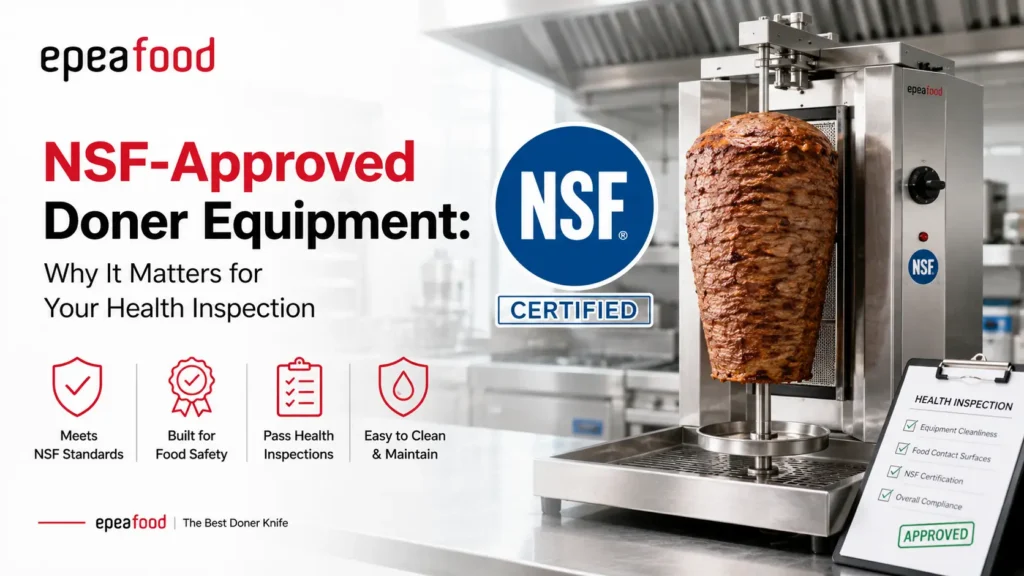
Every doner operation lives or dies by two things: the quality of the meat coming off the spit and the score your health inspector writes on that little card by the register. Most owners obsess over the first one and forget that the second is often decided by the machine itself. An NSF mark on your vertical broiler is not a marketing sticker. It tells the inspector that the equipment was built and tested to standards designed to keep food safe, which changes how the whole visit goes.
If you are buying a rotisserie, a slicer, or a shawarma unit and the NSF certification is not part of the conversation, you are leaving your inspection result up to chance. This guide breaks down what that certification means in practice, how it shapes your kitchen’s compliance, and what to look for before you spend a dollar on new gear.
What NSF Certification Actually Means for Doner Equipment
NSF is an independent organization that tests and certifies foodservice equipment against public health and sanitation standards. When a doner broiler carries the NSF mark, it means the unit was evaluated for how easily it can be cleaned, whether its materials are safe for contact with food, and how well its design prevents bacteria from building up in hidden corners. It is not a claim the manufacturer makes about itself. It is a verdict from a third party with no stake in the sale.
The relevant standard for cooking equipment focuses on things most operators never think about until a problem shows up. Smooth welds instead of sharp seams where grease can hide. Rounded interior corners that a cloth can actually reach. Surfaces that hold up to repeated washing with commercial sanitizers without pitting or corroding. These details sound small on paper, but they are exactly the spots inspectors probe first.
For a doner setup specifically, the stakes are higher than for a lot of other equipment because you are cooking large stacks of meat over long hours, with fat dripping and pooling the entire time. A machine that traps that runoff in an area you cannot scrub becomes a breeding ground. Certified units are designed with drip management and accessible cleaning in mind, which is why serious suppliers build their doner kebab equipment around these requirements from the start rather than treating them as an afterthought.
How Health Inspectors Read Your Equipment During a Visit
Walk through a health inspection from the inspector’s side of the counter and you start to understand why certified gear makes life easier. They are not just checking temperatures. They are looking at whether your equipment can be kept clean under real working conditions, and whether it is being kept clean right now.
When an inspector sees an NSF mark, it removes a whole layer of doubt. They know the unit’s construction already passed a sanitation review, so their attention shifts to how you are maintaining it rather than whether the machine itself is a liability. That is a meaningful difference. A non-certified unit invites closer scrutiny, more questions, and more written notes, because the inspector has no baseline assurance and has to judge everything from scratch.
The plate or label matters too. Many jurisdictions expect commercial cooking equipment to carry certification from a recognized body, and some will flag or even reject equipment that has none. An uncertified machine can turn into a citation on its own, separate from any actual cleanliness issue. In short, the mark quietly answers questions before they get asked, and that keeps the visit moving in your favor.
The Real Risks of Running Non-Certified Gear
Plenty of operators buy cheaper, uncertified equipment thinking they saved money, then spend far more dealing with the fallout. The costs rarely show up on the first day. They surface later, usually at the worst possible time.
Here is what non-certified doner equipment tends to put on the table:
- Failed or downgraded inspections. Uncertified construction can be cited directly, and hard-to-clean designs make it far easier to rack up violations that drop your public health grade.
- Food safety incidents. Grease traps you cannot reach and porous surfaces hold bacteria. That raises the odds of contamination, which is the fastest route to a customer complaint or worse.
- Faster wear and hidden repair costs. Lower-grade metals corrode and warp under constant heat and daily washdowns, meaning you replace parts, or the whole unit, sooner than you planned.
- Insurance and liability headaches. If a foodborne illness gets traced back to your kitchen, uncertified equipment weakens your position and can complicate coverage.
- Reputation damage. A posted low grade in the window or a bad review mentioning cleanliness follows you around far longer than the price difference on the machine ever justified.
None of this means expensive equipment is automatically better. It means certification is the floor, not a luxury. Buying gear that skips it is a gamble where the house usually wins.
Materials and Design Features That Pass Inspection
The difference between equipment that sails through inspection and equipment that gets picked apart usually comes down to what it is made of and how it is put together. You do not need to be an engineer to spot the good signs.
Stainless steel is the backbone of compliant doner equipment, and not all stainless is equal. Food-grade grades resist corrosion, tolerate high heat, and stand up to the acids and salts in marinated meat without breaking down. That durability is not just about lifespan. A surface that stays smooth stays cleanable, and a cleanable surface is a passable surface. Once metal starts pitting, those tiny cavities hold residue no rag will remove.
Construction details do just as much work as the material. Look for continuous welds rather than bolted seams in high-contact areas, since every gap is a place for grease and juice to collect. Removable components, whether it is the drip tray, the fat collection channel, or the spit assembly, let you break the machine down and reach surfaces that would otherwise stay dirty. A unit designed to come apart for cleaning is a unit designed to pass.
Heat management belongs in this conversation too. A well-built vertical broiler directs runoff into a collection point you can empty and sanitize, instead of letting it settle where you cannot reach. When you compare options across a supplier’s product range, these are the features worth weighing far more heavily than a slightly lower sticker price.
NSF Certification Versus Other Marks: Knowing the Difference
Shop for commercial equipment for a while and you will run into a wall of logos and abbreviations. It is easy to assume they all mean roughly the same thing, but they do not, and mistaking one for another can leave a gap in your compliance.
NSF specifically addresses sanitation and food safety design. Other marks you will see, like electrical safety certifications, confirm the unit is safe to power and operate, which is important but answers a completely different question. An electrical listing tells you the machine will not shock someone or start a fire. It says nothing about whether you can clean it well enough to keep food safe. You often want both, but you should not treat one as a substitute for the other.
Some manufacturers lean on vague language, calling equipment “NSF compliant” or “built to NSF standards” without actually holding the certification. That phrasing is a red flag. Real certification means the specific model was tested and listed, and you can usually verify it. If a seller cannot point you to proof, treat the claim as marketing until shown otherwise.
Briefly, the smart move is to ask directly which certifications a given unit actually carries, for what, and how you can confirm it. A reputable supplier answers that plainly. If the question makes them uncomfortable, that tells you something on its own.
Cleaning and Maintenance That Keeps You Compliant
Certified equipment gives you a strong starting point, but it does not clean itself. The machine can only pass inspection if your daily habits keep it in the condition it was certified to reach. This is where a lot of otherwise well-equipped kitchens slip.
The advantage of a well-designed doner unit is that it makes the right routine faster, not slower. Because certified equipment is built to come apart and expose its surfaces, a thorough clean at close does not have to eat your whole evening. The trays lift out, the collection areas rinse clear, and the surfaces wipe down without a fight. When cleaning is easy, it actually gets done, and consistency is what inspectors reward.
Build the routine around the parts most likely to cause trouble. Grease runoff points, the area directly behind the meat stack, and any seams near the heating element deserve attention every single day, not just before an inspection you know is coming. Trying to catch up on weeks of buildup the night before a visit almost never works, because residue that has cooked onto a surface repeatedly does not come off with a single scrub.
Documentation helps more than people expect. Keeping a simple cleaning log, even a basic one, gives you something concrete to show an inspector and reinforces the habit internally. If you want structured guidance on getting the most out of your setup, a supplier’s how-to resources can walk your team through proper handling and upkeep step by step.
Choosing NSF-Approved Doner Equipment for Your Kitchen
By the time you are ready to buy, the decision should feel less like a leap and more like a checklist. You know what certification means, why inspectors care, and what construction to look for. The last step is matching the right unit to how your kitchen actually runs.
Start with volume and space. A high-turnover restaurant and a small takeaway counter have very different needs, and buying too large or too small creates its own problems. An oversized broiler running half empty wastes energy and leaves meat sitting in a heat zone longer than ideal. A unit that cannot keep up forces you to overload it. Certified equipment comes in a range of capacities for exactly this reason, so size the machine to your real demand rather than your busiest imagined day.
Think about the whole workflow, not just the cooker. If you are slicing high volumes, your sliced protein handling and your doner kebab production need to move in sync with the broiler, and equipment that plays well together keeps the line clean and efficient. Certification on each piece means every touchpoint in that flow meets the same sanitation bar, which is what an inspector is really evaluating.
Finally, buy from a source that treats certification and support as part of the deal rather than a bonus. Ask about documentation, replacement parts, and service before you commit. If a question about compliance comes up later, you want a partner who picks up the phone. When you are comparing suppliers, reach out through their contact page and judge them partly on how clearly they answer. The right one makes your next inspection a formality instead of a fear.
Frequently Asked Questions
Is NSF-approved doner equipment legally required?
It depends on your local health code. Many jurisdictions require commercial cooking equipment to carry certification from a recognized sanitation body, and some inspectors will cite or reject uncertified units outright. Even where it is not strictly mandated, certified equipment makes passing far easier, so most operators treat it as a practical requirement rather than an optional upgrade.
Does the NSF mark guarantee I will pass my inspection?
No, and any seller who promises that is overselling. Certification confirms the equipment is designed to be kept clean and safe. Passing still depends on how well you maintain it day to day. Think of it as a strong foundation that removes one major source of risk, not a substitute for good cleaning habits.
How can I verify a unit is actually certified and not just “compliant”?
Look for the physical certification mark on the equipment and ask the manufacturer for the specific model listing. Genuine certification applies to a tested model and can usually be confirmed. Phrases like “meets NSF standards” without a real listing are not the same thing, so ask for proof and be cautious if a seller cannot provide it.
Can I retrofit or clean up older equipment to pass instead of replacing it?
You can improve maintenance and cleanliness on any unit, and that helps. What you cannot change is the underlying construction. If an older machine has hard-to-reach areas, corroded surfaces, or seams that trap grease, no amount of scrubbing fixes the design flaw. At some point, replacing it with a certified unit is cheaper than repeatedly fighting the same violations.
Is certified equipment worth the higher upfront cost for a small operation?
For most operators, yes. The price gap tends to be smaller than people assume, and it is easily outweighed by the cost of a failed inspection, faster wear on cheaper metals, or a food safety incident. Smaller kitchens actually have less margin for error, which makes the reliability of certified gear more valuable, not less.