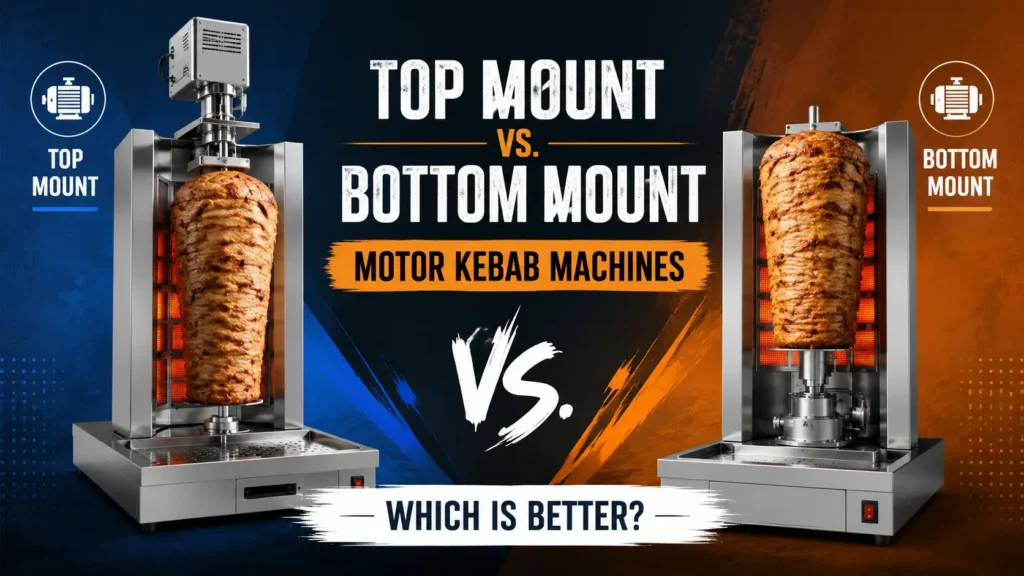
Kebab machines come in two main motor configurations, and the placement of that motor changes far more than most buyers realize when they walk into a kitchen equipment store. A top mount motor sits above the meat stack and rotates it from the upper shaft, while a bottom mount motor drives the rotation from the base. Both produce a turning skewer, but they behave differently under heavy daily use, react differently to grease and heat, and carry different long-term costs. Choosing the wrong one for your kitchen layout or volume can mean replacing a motor within two years instead of seven.
This guide breaks down the practical differences, the real-world advantages and weaknesses of each design, and the conditions that make one a smarter purchase than the other.
Key Differences Between Top and Bottom Mount Kebab Machines
The most obvious distinction is structural. A top mount machine carries its motor inside a housing above the meat skewer, with the drive shaft pointing down. A bottom mount machine reverses this entirely, placing the motor and gear assembly in the base, with the shaft pushing up through the bottom plate. From the outside the cooking experience looks similar, but the engineering behind that smooth rotation is built around two different philosophies.
Heat behavior is where these two designs really part ways. Hot air rises, and in a vertical kebab grill the area directly above the meat becomes the hottest zone of the entire machine. Top mount motors sit right in that zone, which means their internal components, lubricants, and electronic controls operate under constant thermal stress. Bottom mount motors stay closer to ambient temperature because they sit below the heat source, and that single fact influences nearly every other comparison point on this list.
The way each model handles the weight of the meat also differs in a way operators feel daily. Top mount systems hang the skewer from above, so the motor essentially pulls the load. Bottom mount systems push the load upward and balance it on a base bearing, which tends to be more stable for very heavy stacks but requires a sturdier base bearing to handle the vertical pressure.
Finally, accessibility plays a role most buyers underestimate. Reaching a top mount motor usually means dismantling the upper canopy, while bottom mount motors can often be serviced by opening a base panel without disturbing the cooking area at all.
Pros and Cons of Top Mount Kebab Machines
Top mount machines have a strong following in busy döner shops, and the reasons go beyond tradition. The biggest practical advantage is the clean base. With no motor housing at the bottom, the drip tray sits flat and wide, catching juices and fat without anything obstructing the flow. Cleaning the lower section becomes a much faster job, and there are no electrical components down there that you need to worry about when wiping or rinsing.
The second strength is balance under uneven loading. When a kebab is partially carved during service, the remaining meat is rarely shaped evenly. A top mount motor handles this lopsided rotation more gracefully because the load hangs naturally from a single fixed point above. You get a steadier turn even when half the stack has been sliced away.
There are real drawbacks, though. Top mounted motors operate in the hottest part of the machine, and prolonged exposure to high temperatures shortens the life of plastic gears, wiring insulation, and bearing grease. Operators who run their machines twelve hours a day notice this difference within the first two years of ownership. Replacing the motor itself can also be more involved because the upper housing has to come apart, and grease and carbon often build up on the screws holding it together.
Another smaller issue is visual. The top canopy is bulkier on these models, which slightly limits how close you can position the machine to a low hood or under a shelf. In tight kitchens this matters more than it sounds.
Advantages of Bottom Mount Kebab Machines
Bottom mount designs have gained ground steadily over the last decade, especially in commercial kitchens that prioritize longevity. Placing the motor in the cool base shields it from the radiant heat of the burners, which is the single most important factor in extending motor life. Operators commonly report bottom mount motors running smoothly past the seven or eight year mark in busy shops, while top mount motors in similar conditions often need attention much sooner.
Maintenance is also more straightforward in most cases. The motor compartment opens from the side or rear of the base, and a technician can inspect bearings, check the gear assembly, or replace a capacitor without taking apart the cooking area. Service calls are usually shorter and less disruptive to a working kitchen.
Bottom mount machines also tend to handle very heavy meat stacks with confidence. Because the load sits on a base bearing rather than hanging from above, the rotation stays smooth even with twenty or thirty kilos of meat on the skewer. For high volume restaurants this stability translates into better cooking consistency throughout the day.
The trade-off is a more complex base. The motor housing takes up space that would otherwise be open, which can complicate cleaning the drip area and make grease accumulation harder to spot early. Electrical components living near the bottom also require careful sealing, and a poorly built bottom mount machine can develop problems if liquids reach the motor compartment.
Cleaning and Maintenance: Which Model is Easier to Maintain?
Daily cleaning and long-term maintenance are two different conversations, and the answer flips depending on which one you mean. For the quick end-of-shift wipe down, top mount machines have the edge. The base is open, the drip tray slides out cleanly, and there are no electrical parts at floor level to navigate around. A staff member can deep clean the lower section in a few minutes without worrying about water getting into anything sensitive.
Weekly and monthly maintenance tells a different story. The areas that need regular attention tend to favor bottom mount designs:
- The motor compartment opens from the base without dismantling the cooking canopy
- Drive shafts on bottom mount models are usually accessible from below for lubrication
- Bearing inspection takes minutes rather than requiring full disassembly
- Heat related wear is minimal, so checks are routine rather than corrective
- Electrical connections sit in a cooler, more predictable environment
Annual servicing and repair work, when motors actually need attention, is also less invasive on bottom mount units. A technician can replace gears, rewind motors, or swap out capacitors while the upper structure remains untouched. Top mount machines often require removing the entire upper canopy, which adds labor cost to every major service.
The honest summary is that top mount wins the quick clean and bottom mount wins almost everything beyond that. For a small shop with simpler service needs the daily ease may matter most, while a high volume operation usually benefits from the deeper accessibility of a bottom mount design.
Motor Lifespan and Durability: Which One Lasts Longer?
Motor lifespan is the question most owners actually care about, because a kebab machine is a long-term purchase and motor replacement is the most expensive repair these units typically face. The pattern across the industry is consistent: bottom mount motors generally outlast top mount motors when both machines are run under similar conditions. The reason is almost entirely thermal.
A motor’s life is largely determined by the temperature its internal components experience over time. Bearing grease breaks down faster in heat, plastic gears warp and lose tolerance, and electrical insulation degrades. A top mount motor sitting in the rising heat column of an active grill is exposed to all of this constantly during operating hours. Even a well-built top mount motor running at high temperatures often shows signs of wear within four to five years of heavy use.
Bottom mount motors avoid this exposure almost entirely. Sitting below the burners and shielded by the base structure, they operate close to room temperature. The grease lasts longer, the gears hold their tolerances, and the electrical components age at a normal rate. Seven to ten years of service is realistic for a quality bottom mount motor used in a busy commercial setting.
That said, build quality matters more than placement when comparing specific models. A cheaply built bottom mount motor with low quality bearings will fail before a well-engineered top mount motor from a reputable manufacturer. The placement advantage applies when comparing similar quality tiers, and it becomes more pronounced the harder the machine is worked.
Does Motor Placement Affect Cooking Quality?
Cooking quality is influenced more by rotation consistency than by motor location, but motor placement does affect rotation consistency in subtle ways. A skewer that turns at a steady pace produces evenly cooked meat with a uniform crust, while wobble or speed variation creates uneven browning and dry spots. Both designs can deliver excellent rotation, but they encounter different challenges in achieving it.
Top mount machines hang the load from above, which means the motor is essentially holding the meat in place against gravity while turning it. With a fresh, well-packed stack this works beautifully. As the meat is carved during service and the load becomes uneven, the top mount design naturally compensates because the suspension point allows the stack to find its own balance. Rotation stays smooth even when the stack looks lopsided.
Bottom mount machines balance the load on a base bearing. With a heavy, well-built stack this produces extremely stable rotation, especially valuable in high volume settings where stacks can weigh thirty kilos or more. The trade-off appears when the stack becomes uneven during service. A poorly built bottom mount can develop a slight wobble at this stage, although well-engineered models manage it without trouble.
Realistically, the difference in cooking quality between the two designs is minor in everyday operation. Burner quality, meat preparation, distance from the heat source, and rotation speed have far larger effects on the final result. Anyone choosing between top mount and bottom mount on cooking performance alone is splitting very fine hairs.
Budget and Performance: Which is the Best Investment for Your Business?
Initial purchase prices are usually similar between comparable top mount and bottom mount machines, with bottom mount models often costing slightly more due to the more complex base structure. The real financial comparison happens over the life of the machine, not at the moment of purchase, and the calculation depends heavily on how the machine will be used.
Here are the factors that actually shape return on investment over a five to ten year window:
- Daily operating hours: longer hours favor bottom mount due to reduced thermal stress on the motor
- Meat volume per day: heavy stacks favor bottom mount stability, smaller stacks work well on either design
- Staff cleaning routine: simpler base cleaning favors top mount in shops with limited cleaning time
- Service availability: easier in-base access favors bottom mount in areas with reliable technicians
- Expected machine lifespan: longer ownership periods favor bottom mount due to higher motor longevity
- Replacement motor cost: factoring in one or two motor replacements changes the total cost picture significantly
For a small kebab shop running moderate volume with a six to eight hour service day, a quality top mount machine offers excellent value and slightly easier daily cleaning. For a busy döner restaurant running twelve hours or more with large meat stacks, a bottom mount machine almost always wins on total cost of ownership because the motor simply lasts longer and needs less invasive servicing.
Build quality should weigh heavier than configuration in the final decision. A well-made top mount machine from a respected manufacturer will outperform a poorly built bottom mount every time, regardless of where the motor sits.
Which Model is Right for Your Business?
The right choice comes down to matching the machine to the actual demands of your kitchen rather than following a general rule. A top mount kebab machine suits operations that prioritize easy daily cleaning, run moderate hours, and work with smaller to medium meat stacks. Cafés, smaller restaurants, and shops with simpler service patterns often find this design more practical for everyday work, and the open base makes staff training on cleaning routines straightforward.
A bottom mount kebab machine suits high volume operations, long service hours, and kitchens where motor longevity matters more than daily cleaning speed. Busy döner restaurants, food court locations, and any setting where the machine runs most of the day will see real benefits from the cooler motor environment and easier service access. The slightly more complex base is a manageable trade-off when balanced against years of additional motor life.
Beyond volume and hours, consider your local service support. If reliable technicians are available, bottom mount models offer easier deep maintenance. If service options are limited and you need a machine that staff can keep clean and running with minimal intervention, top mount simplicity has real value.
Whichever direction you choose, prioritize build quality, motor specifications, and warranty terms over the configuration debate. A quality machine of either type, matched honestly to the way your kitchen actually operates, will serve you well for many years.