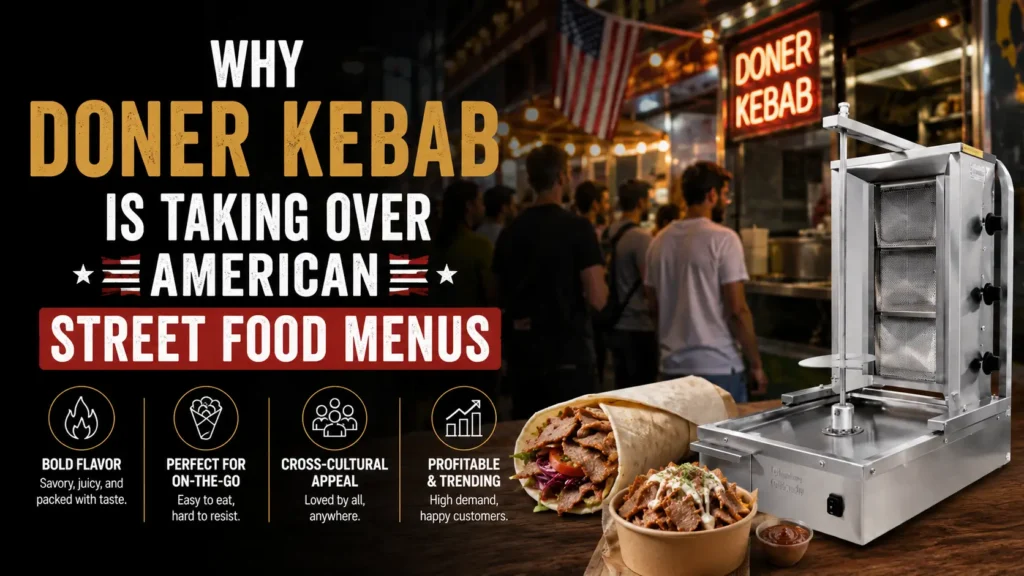
Walk past a busy corner in Los Angeles, Austin, or Brooklyn after dark and you will spot something that was rare ten years ago: a vertical rotisserie turning slowly, stacked with seasoned meat, and a line of people waiting for it. Doner kebab used to sit quietly inside Mediterranean restaurants as a specialty item. Today it stands shoulder to shoulder with burgers, tacos, and pizza in the fight for the late-night dollar.
This did not happen by chance. A combination of immigration, social media, smarter kitchen economics, and a younger crowd that wants bolder flavor has pushed doner from the edge of the menu to the center of it. Operators who once treated it as a side option now build their whole concept around it.
What follows is a clear look at the reasons behind the rise, from the European roots of the modern doner sandwich to the franchise potential investors are starting to chase. If you run a kitchen, a truck, or a growing chain, this is a trend worth reading before the shop down the street gets there first.
The European Connection: How Berlin-Style Doner Reached the US
The doner kebab Americans line up for owes as much to Berlin as it does to Istanbul. The vertical roasting method has deep roots in Turkey, but the sandwich format most people recognize today, with warm flatbread, fresh salad, and a generous drizzle of sauce, was shaped by Turkish workers living in Germany during the early 1970s. They needed a quick, filling meal that travelled well on a city street, and the wrapped doner answered that need perfectly.
From Germany the format spread across Europe, becoming the default cheap and satisfying meal in cities like London, Amsterdam, and Vienna. An entire generation of Europeans grew up associating doner with a good night out and a fast, honest dinner. That cultural memory matters, because many of the people opening kebab shops in American cities either lived in Europe or grew up around that food culture.
The American version is now arriving with that European blueprint built in. Instead of copying a sit-down restaurant model, new operators are recreating the fast, street-level experience that made doner kebab a staple abroad. The result feels familiar to anyone who has visited Europe and brand new to everyone else, which is exactly the kind of crossover that turns a regional dish into a national habit.
Doner vs. Shawarma vs. Gyro: What Is the Actual Difference?
Ask three different customers what they just ordered and you might hear three different names for what looks like the same thing. The confusion is fair, because doner, shawarma, and gyro all share the same basic idea: seasoned meat stacked on a vertical spit and shaved off as it cooks. The differences live in the seasoning, the meat, and the sauces that go on top.
For operators, knowing the distinction is not trivia. It shapes how you describe the menu, how you train staff, and how you market to a curious but uncertain audience. Here is the short version of how the three compare:
- Doner: Turkish in origin, usually beef, lamb, or chicken seasoned with a blend that leans warm and savory. Often served in flatbread or a bun with salad and a yogurt or garlic based sauce.
- Shawarma: Middle Eastern, typically marinated in spices like cumin, cardamom, and turmeric. Frequently paired with garlic sauce, pickles, and tahini, and wrapped in thin flatbread.
- Gyro: Greek, most often made with a seasoned pork or lamb and beef blend. Served in pita with tomato, onion, and a cool tzatziki sauce.
Once you put it that way, the overlap stops feeling like a problem and starts looking like an opportunity. A single kitchen can offer a gyro, a shawarma, and a doner from a shared base of equipment and technique, giving guests variety without forcing the kitchen to run three separate systems. That flexibility is part of why so many menus now carry all three.
Why Late-Night Crowds Are Choosing Kebabs Over Pizza
Pizza ruled the late-night slot for decades because it checked every box: cheap, filling, easy to share, and available everywhere. That dominance is no longer guaranteed. After midnight, more and more people want something that feels fresh rather than heavy, and a warm kebab loaded with grilled meat and crisp vegetables fits that mood better than another greasy slice.
There is also a flavor factor at work. The late-night customer in 2025 has grown up with global food and has a higher tolerance for spice and seasoning than the generation before. A plain cheese slice can feel flat next to a wrap packed with marinated meat, fresh herbs, pickles, and a sauce with real punch. Kebabs deliver intensity, and intensity is what tired, hungry people remember and come back for.
Speed seals the deal. A skilled cook can shave, build, and hand over a doner in well under two minutes, which matters when a bar empties out and forty people want food at once. The vertical rotisserie is essentially always ready, so there is no waiting for an oven cycle. For the customer that means a hot meal fast, and for the operator it means turning a rush into revenue instead of a backlog.
Finally, the format simply suits walking. A wrapped kebab is built to be eaten on the move, with one hand, on the way home. Pizza by the slice can do this too, but a sealed wrap holds together better and makes less of a mess. In a city where the night ends on foot or in a rideshare, that small detail wins a lot of orders.
High Profit, Low Waste: Why Food Trucks Are Making the Switch
Food trucks live and die by their margins, and doner kebab happens to be one of the most forgiving products a small operation can run. The meat is portioned by the shave, so the cook only cuts what the order needs. Nothing sits getting cold on a tray waiting to be thrown out at close. That single trait fixes one of the biggest sources of loss in any kitchen.
The economics get even better when you look at the full picture of how a kebab program runs:
- Minimal waste: Meat is shaved to order, so portions match demand instead of guesswork.
- Low labor needs: One trained cook can handle a steady line, which keeps payroll lean.
- Small footprint: A vertical broiler takes up far less space than a full grill line, a real advantage inside a truck.
- Consistent cost control: Buying pre-stacked, seasoned cones removes prep time and locks in portion size.
- High ticket flexibility: The same protein sells as a wrap, a plate, a box, or a loaded fries dish at different price points.
Sourcing makes the model even simpler. Operators who buy ready-to-cook sliced proteins skip hours of marinating and stacking, and pairing those with the right doner kebab equipment turns a tight truck kitchen into a fast, repeatable system. For a new owner watching every dollar, that mix of low waste, low labor, and high flexibility is hard to beat, which is exactly why so many trucks are quietly swapping their old menus for a spinning cone of meat.
The Rise of Customization: Fitting the American Fast-Casual Model
American diners have been trained by the fast-casual boom to expect choice. They want to walk a line, point at ingredients, and watch their meal come together their way. Doner kebab slides into that model with almost no friction, because the dish was always meant to be built rather than plated.
That build-your-own structure gives kebab concepts a natural edge. A guest can pick their protein, choose between a wrap, a bowl, or fries on the side, and then decide how far to push the heat and the sauce. The kitchen handles the cooking, but the customer feels in control of the outcome, and that sense of ownership keeps people coming back to try new combinations.
It also lets one menu reach very different appetites. The same station can serve a light bowl with extra salad for a health-minded lunch crowd and a loaded, sauce-heavy wrap for the late shift. Blended concepts take this even further, with a burger and kebab lineup that lets a group order across cultures without anyone leaving unhappy. Few formats stretch that easily.
For operators, customization is not just a marketing line, it is a way to raise the average ticket. Add-ons like extra protein, premium sauces, cheese, or a side upgrade turn a basic wrap into a higher-value order without slowing the line. Browsing a full product range early helps owners design a menu where every add-on has a purpose and a price.
Social Media Hype: How TikTok Fueled the Kebab Boom
You cannot explain the kebab surge without talking about the phone in everyone’s hand. Food that looks good in a ten second clip travels fast, and a kebab being shaved off the spit, juices catching the light, sauce being drizzled in slow motion, is built for exactly that kind of video. The visual drama does the advertising before the customer ever tastes anything.
TikTok in particular rewarded this content. Clips of cones turning, knives flashing, and overstuffed wraps being folded racked up millions of views and sent viewers searching for the nearest place to try one. A single viral video can put a small shop on the map overnight and create lines that stretch down the block for weeks. That is reach a tiny marketing budget could never buy on its own.
The effect compounds because the food matches the hype. Plenty of trends look better than they taste and fade quickly, but a well made kebab actually delivers on the promise of the video. People film their order, the order is genuinely good, and the cycle repeats. In short, social media did not invent the demand, it simply lit the fuse on a product that was already worth eating.
Is Doner Kebab the Next Big American Franchise Opportunity?
Every major American food category started somewhere as a scrappy independent idea before someone systematized it into a national brand. Burgers, fried chicken, burritos, and pizza all followed that path. Doner kebab now sits right at the edge of that same transition, with strong demand, proven economics, and almost no dominant national chain claiming the space.
That gap is the opportunity. The dish already passes the hard tests a franchise model demands. It can be standardized, the equipment footprint is small, the labor needs are low, and the product carries enough margin to support both the operator and a brand fee. Add the cultural momentum behind it and you have the early shape of a category waiting for its breakout name.
There are real questions to answer before that happens. Supply chains need to deliver consistent, food-safe protein at scale, and a brand has to keep quality steady from one location to the next. A franchise built on a viral moment but no operational backbone will not last. The winners will be the groups that treat consistency as seriously as flavor, and that lean on a reliable supply partner from day one.
For anyone weighing the move, the timing argument is strong. Getting in while the category is still forming means lower competition and room to define what the experience should be, rather than copying someone else later. Operators who want to explore the numbers and sourcing in detail can start the conversation through a quick contact and build a plan around real costs instead of guesswork.