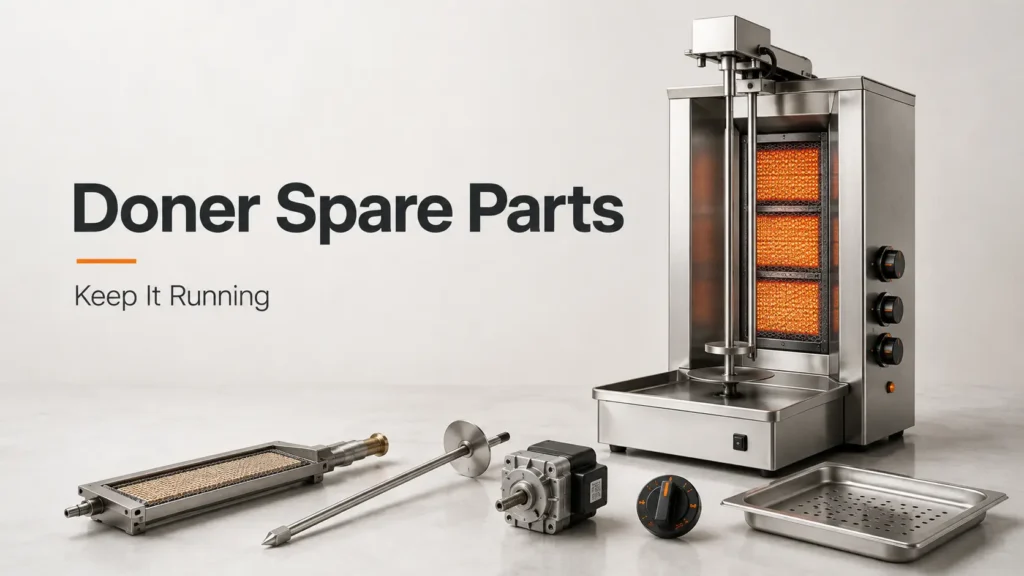
A doner machine is one of the few pieces of equipment in a kitchen that runs almost non-stop through service. The motor turns for eight or ten hours straight, the burners sit at high heat all day, and the spit carries anywhere from 20 to 100 pounds of meat while it does. Parts wear out. That is not a sign of a bad machine, it is simply what happens when a mechanical device works that hard, six or seven days a week.
The good news is that almost nothing on a vertical broiler is unfixable. Motors, burners, gas jets, skewers, discs, bearings, switches and thermostats are all replaceable items, and most of them cost a fraction of a new unit. A shop that keeps two or three common spares in a drawer rarely loses a full day of service. A shop that waits until something dies mid-lunch usually does.
This guide walks through every spare part that actually fails on a doner or shawarma grill, how to spot the failure before it stops your service, and what to check before you order a replacement. Whether you run a single machine in a food truck or four of them in a busy restaurant, the same short list of components covers roughly 90% of all breakdowns.
Which Parts Actually Wear Out on a Doner Machine
Start with a simple mental split: parts that move, parts that get hot, and parts that carry current. Almost every failure falls into one of those three groups, and each group fails in a predictable way.
Moving parts are the motor, the coupling between motor and spit, the bearing or plummer block that the shaft sits in, and the spit itself. These wear gradually. You hear the change before you see it, usually as a grinding noise or a rotation that slows down when the cone is full.
Heat parts are the burners, the ceramic or mesh burner face, the gas jets, and the reflector panels behind the flames. They fail by clogging, cracking or corroding. Grease is the main enemy here. Fat drips onto the burner face, carbonises, and slowly blocks the ports until part of the burner runs weak.
Electrical parts are the switches, thermostats, ignition units, wiring looms and control knobs. These are the least dramatic failures but the most annoying, because a $12 switch can put a $4,000 machine out of action just as effectively as a seized motor. Heat and steam are what kill them, especially on machines that get hosed down carelessly at closing time.
Doner Machine Motors: The Part Everyone Replaces First
The motor is the single most common spare part purchase in the trade, and the reason is simple. It is a small gear motor asked to turn a heavy, unbalanced load for hours, in an environment that reaches 60 to 70°C around the housing.
Most commercial machines use a low speed gear motor running somewhere between 1 and 3 rpm, mounted either above the spit or below it. Top mounted motors sit in the hottest air in the kitchen, which shortens their life, but they stay clean because grease falls away from them. Bottom mounted motors run cooler yet collect drips and fat, which is why they need a shield and regular wiping. If you are weighing this up before your next purchase, our comparison of top mount and bottom mount motor kebab machines covers the trade off in detail.
A motor rarely dies without warning. It starts by struggling with a full cone in the morning and running fine once the cone is half eaten. Then it starts stopping and restarting. Then it hums without turning. If you catch it at stage one, you can order the part and swap it during a quiet afternoon instead of losing a Friday night.
When you order, three numbers matter more than the brand name: voltage, rpm and shaft size. A 230V motor on a 110V supply will crawl, and a shaft that is 1mm off will not seat in the coupling. Take a photo of the plate on the old motor before you throw it away. Many suppliers can identify the exact fit from that photo alone.
The coupling between the motor and the spit deserves a mention here too. It is a cheap piece of metal or rubber that absorbs shock, and it is designed to give out before the motor does. If your spit stops turning, check the coupling first. Plenty of shops have bought a new motor when a $15 coupling was the actual problem.
Burners, Gas Jets and Heating Elements
Uneven cooking is the symptom that sends most owners looking at their burners. One radiant panel glowing bright orange while the one below it runs pale is a clear sign that gas flow is not equal across the machine, and the cause is almost always a blocked jet or a fouled burner face.
Gas jets, sometimes called injectors or nozzles, are tiny brass fittings with a precisely drilled hole. That hole is sized for a specific gas type, which is why LPG jets and natural gas jets are never interchangeable. Fitting the wrong one gives you either a lazy yellow flame that sooties the meat or an aggressive flame that scorches the outer layer while the inside stays raw. If you move premises and the gas supply changes, you change the jets. There is no adjustment that substitutes for the right jet size.
Burner faces, whether ceramic plates or stainless mesh, are consumable items on a busy machine. Ceramic cracks from thermal shock, usually when someone sprays cold water on a hot burner during cleaning. Mesh distorts and clogs. Either way, the fix is a straight swap, and most machines let you slide the panel out once the front guard is removed.
Electric machines have a different set of parts but the same logic. Quartz tubes and infrared elements dim, sag or fail outright, and a single dead element on a four element machine will leave a cold band on the cone that never browns properly. If your meat is browning in stripes rather than evenly, that is the first thing to check. We covered the wider causes of this problem in our guide on why doner cones cook unevenly.
Skewers, Discs and Rotating Assembly Parts
Everything that holds the meat and turns it counts as the rotating assembly, and while these parts look indestructible, they take more abuse than any other section of the machine. Here is what typically needs replacing and why.
- Spits and skewers. The main rod bends if a frozen cone is forced onto it or if someone leans on it during loading. A bent spit wobbles, and that wobble transfers straight into the motor gearbox. Once you see the cone swaying as it turns, replace the rod rather than waiting.
- Support discs and plates. These sit under the cone and carry its full weight. Warped discs let the meat sag to one side, which throws the balance off and creates the same uneven cooking you would blame on the burners.
- Holding pins and locking collars. Small, cheap and easy to lose. Without them the cone creeps down the spit during service. Buy spares in pairs and keep them in the same drawer as your knife charger.
- Plummer blocks and bearings. The bushing at the top or bottom of the spit takes constant lateral load. When it wears, you get a rattle at every rotation and eventually a spit that sits off centre.
- Drip trays and fat collection pans. Not glamorous, but a cracked or badly fitting tray sends fat onto the burner and turns a maintenance job into a fire risk.
- Side reflectors and heat shields. Stainless panels warp over years of heat cycling. Replacing them restores heat direction toward the meat instead of out into the kitchen.
None of these items is expensive individually. Together they are the difference between a machine that cooks a clean, even cone and one that fights you through every service. If you are still deciding which machine size suits your volume, the way these parts are built matters more than the badge on the front, and our breakdown of choosing a doner machine by daily meat volume is a useful place to start.
Electrical Components, Switches and Thermostats
Electrical parts do not announce themselves the way a grinding motor does. The machine simply refuses to do something it did yesterday, and the cause sits behind a panel you have never opened.
Rocker switches and rotary knobs fail from heat and from greasy fingers pressing them thousands of times. The contacts pit, and eventually the burner bank they control stops responding. A quick test: if wiggling the switch brings the burner back to life, the switch is done. It is a five minute replacement on most machines.
Thermostats and safety cut outs matter more than owners realise. On electric units, a failed thermostat either lets the elements run flat out until something scorches, or it trips constantly and leaves you restarting the machine every twenty minutes. On gas machines, the thermocouple and flame failure device are safety parts, not optional extras. If a burner lights and dies three seconds after you release the knob, that is a thermocouple telling you it can no longer sense the flame.
Wiring looms sit in a hot cabinet for years. Insulation hardens, cracks and eventually shorts. Any browning or brittleness around terminal blocks is a signal to replace the section rather than tape it. This is one job where calling a qualified engineer is genuinely cheaper than the alternative, particularly in a commercial kitchen where an insurance inspection may follow any incident.
One practical habit: photograph the inside of the control box while everything still works. When a wire comes loose two years from now, that photo will save you an hour of guessing.
Doner Knife and Slicer Spare Parts
The slicer is technically a separate tool, but it breaks down with the same regularity as the machine itself, and shops that ignore it end up carving with a dull blade that shreds meat instead of shaving it.
Electric doner knives run on a small motor with a gear head, and the failure points are the blade, the carbon brushes, the drive coupling and the power cable. Brushes are the classic overlooked part. When the knife starts sparking visibly at the housing or loses power under load, worn brushes are usually the cause, and a new pair costs a few dollars.
Blades themselves are consumables. A circular slicer blade can be sharpened several times before the diameter drops enough to affect the cut, after which it needs replacing. Running a dull blade increases waste noticeably, since ragged slices weigh more per portion and look worse in the wrap. Our overview of the best doner knife options explains what to look for when the time comes to replace one entirely.
Battery powered slicers add one more consumable: the battery pack. Lithium packs lose capacity after a couple of years of daily charge cycles, and a knife that used to last a full lunch rush but now fades after thirty minutes needs a new pack, not a new knife.
How to Diagnose a Fault Before You Order a Part
Ordering the wrong part is the most common way shops waste money on repairs. A short diagnostic pass takes ten minutes and usually points straight at the culprit.
- Spit does not turn at all. Check power at the socket, then the switch, then the coupling, then the motor. Order in that sequence, not the reverse.
- Spit turns slowly or only when the cone is small. The motor is weakening, or the bearing is binding. Spin the spit by hand with the motor disconnected. If it resists, the problem is mechanical, not electrical.
- One burner section runs weaker than the others. Blocked jet or fouled burner face. Clean first, replace if cleaning does not restore an even blue flame.
- Burner lights then goes out after a few seconds. Thermocouple or flame failure device.
- Meat browns in stripes rather than evenly. Dead element on electric machines, blocked burner on gas machines, or a warped support disc letting the cone sit off centre.
- Grinding or knocking with every rotation. Worn bearing or bent spit. Both should be dealt with quickly, since either one will destroy a motor if left running.
- Knife loses power under load. Carbon brushes, then the gear coupling, then the motor.
Work through the cheap possibilities before the expensive ones. In practice, a coupling, a jet or a switch resolves more faults than a motor does, and each of those costs a small fraction of what a motor costs. When you do need advice on fitment for a specific model, our team can help through the contact page.
Choosing the Right Replacement Part for Your Machine
Compatibility is where most orders go wrong. Doner machines look similar across brands, but the internals are not standardised, and a part that fits an Archway will not necessarily fit a Turkish built or German built unit.
Before ordering anything, find the data plate. It is usually on the back or inside the lower panel, and it carries the model number, serial number, gas type, voltage and power rating. Those details narrow a search from hundreds of options to two or three. If the plate has worn off, measure the part instead: shaft diameter, mounting hole spacing, overall length, thread size. Photographs alongside a tape measure are enough for most suppliers to confirm a match.
Original manufacturer parts and quality aftermarket parts both have a place. Original parts guarantee fitment and usually carry a warranty, which matters for motors and anything gas related. Aftermarket parts make sense for simple mechanical items like pins, discs and drip trays where tolerances are forgiving. What is worth avoiding is the cheapest unbranded motor available, because a motor that fails during service costs far more in lost revenue than the difference in purchase price.
Gas parts deserve one extra rule: they should be fitted by a qualified gas engineer, and in most regions that is a legal requirement rather than a suggestion. Insurance policies for food businesses commonly exclude claims arising from unqualified gas work. The same caution applies to anything that affects certification on the unit, which is worth remembering if your kitchen operates under health department inspection. Machines built to recognised standards make this easier, and we explain why in our piece on NSF certified doner equipment.
Lead time matters as much as price. A part that arrives in two days from a local supplier beats one that saves you 20% and takes three weeks in transit, especially for anything on the critical path like a motor or a burner.
A Maintenance Routine That Cuts Part Replacement in Half
Most premature failures on a doner machine trace back to two things: grease and water. Grease bakes onto burners and works its way into bearings. Water gets sprayed where it should not go and finds its way into switches and motor housings. Control both and your parts bill drops sharply.
Daily, the drip tray should be emptied and wiped, the front guard cleaned, and the spit wiped down once it has cooled. Nothing here takes more than a few minutes at close, and it prevents the fat build up that causes most burner problems. Our guide on cleaning a vertical doner grill quickly covers a routine that fits into a normal closing shift.
Weekly, pull the burner guards and check the flame pattern across every section with the machine cold and then lit. An even blue flame across all ports is what you want. Any yellow tipping or dead spots means a clean is due. Check the coupling for play at the same time, and look for grease pooling anywhere it should not be.
Monthly, inspect the spit for straightness by rolling it on a flat surface, check discs for warping, tighten any fasteners that have vibrated loose, and look inside the control box for discoloured wiring. Ten minutes a month here catches problems while they are still cheap.
The other half of the equation is what you put on the machine. Cones that are badly stacked, unevenly frozen or overweight for the machine put constant strain on the motor and the spit. Using properly formed, correctly sized cones is not just about the food quality, it protects the equipment underneath. If you want the full picture on equipment selection and supply, our doner kebab equipment page brings the machine and product sides together.
Frequently Asked Questions About Doner Machine Spare Parts
How long does a doner machine motor last?
In a busy shop running eight to twelve hours a day, expect three to five years from a quality gear motor, and often longer on a bottom mounted machine that stays cooler. Light use in a small kitchen can stretch that considerably. Overloading the spit and running without maintenance can cut it to a single year.
Can I use any motor on my kebab machine?
No. Voltage, rpm and shaft dimensions must match, and the mounting pattern has to line up with your bracket. A motor that spins too fast dries the meat surface, and one that is underpowered will stall under a full cone.
Why is only one burner on my machine working properly?
Almost always a blocked gas jet or a fouled burner face on the affected section. Clean the jet with a soft brush and compressed air rather than a wire, since enlarging the hole changes the gas flow permanently.
Are LPG and natural gas parts interchangeable?
Only the burner bodies are shared. The jets are drilled to different sizes and must be changed when the gas type changes. This is a job for a qualified gas engineer.
What spare parts should every kebab shop keep on hand?
A spare motor coupling, a set of gas jets, a spare rocker switch, holding pins and a spare knife blade. Together they cost very little and cover the majority of faults that would otherwise stop service.
Is it worth repairing an old doner machine or buying new?
If the frame and burner housing are sound, repairs almost always make financial sense, since parts run into the hundreds while a new commercial unit runs into the thousands. Once the body corrodes or gas certification becomes questionable, replacement is the safer route. Our overview of commercial doner machine costs gives current figures to compare against.
Can I fit spare parts myself?
Mechanical parts such as couplings, discs, pins and drip trays are straightforward with basic tools. Electrical and gas components should be handled by a qualified engineer, both for safety and for insurance reasons.
Keeping the Machine Running Through the Busy Years
In short, a doner grill is a mechanical device with a handful of predictable weak points, and treating those weak points as scheduled consumables rather than emergencies is what separates a shop that runs smoothly from one that improvises through breakdowns. Motors, couplings, jets, burner faces, spits, discs and switches account for the overwhelming majority of downtime, and none of them is expensive when bought ahead of the failure.
Build a small spares kit, learn the diagnostic sequence for the three or four faults you are likely to see, and keep grease and water where they belong. Do that and a good machine will carry you through a decade of service rather than three years of frustration.